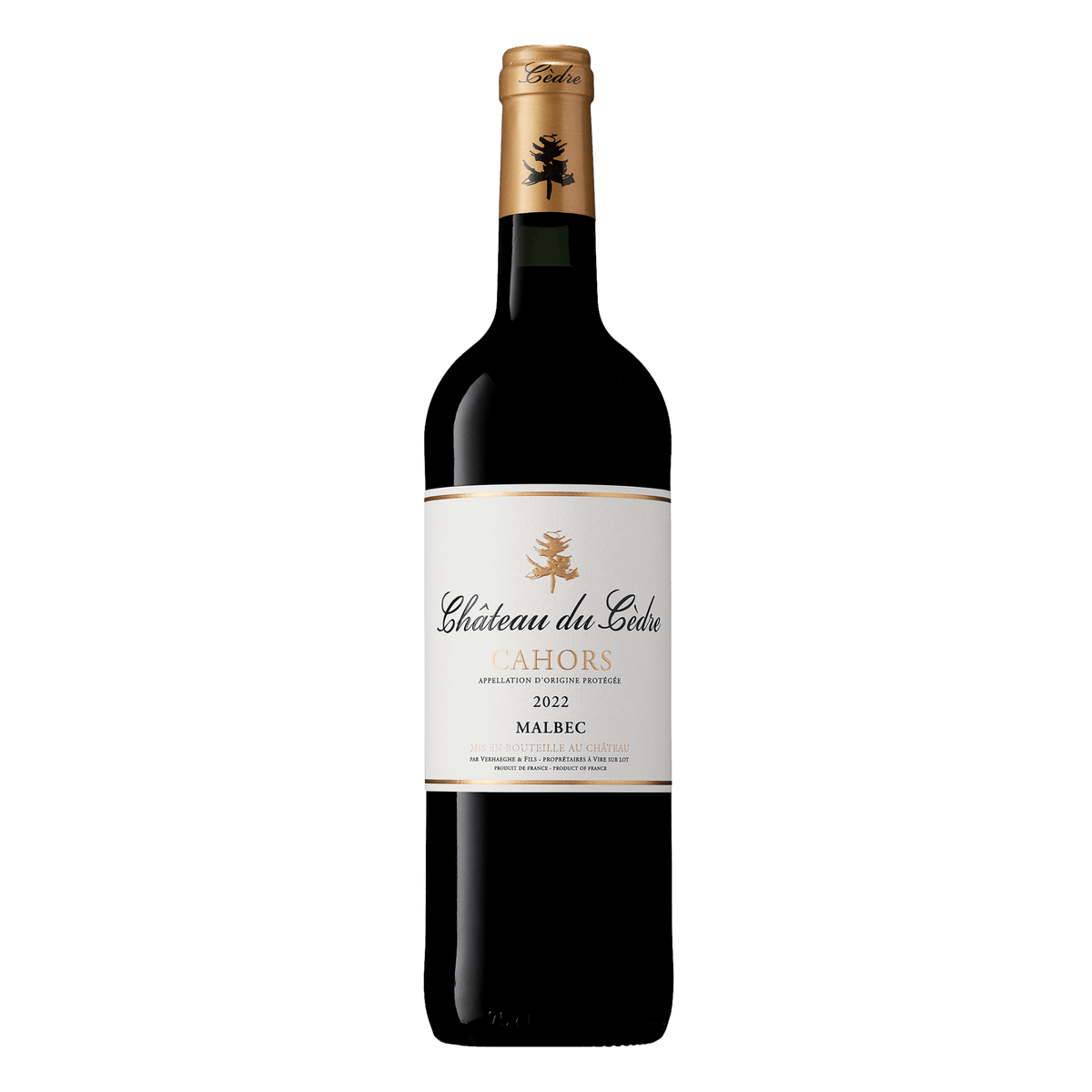
Château du Cèdre
Château du Cèdre Cahors Château 2022
Château du Cèdre Cahors Château 2022
Couldn't load pickup availability
Description
Description
Château du Cèdre Cahors Château is the estate's core appellation wine, pure Malbec from its older terrace and causse parcels.
Cahors lies on the river Lot upstream of Bordeaux and is the historic home of Malbec, known locally as Côt or Auxerrois. Château du Cèdre is at Vire-sur-Lot at the warm western end of the valley, where the Verhaeghe family farm around thirty certified organic hectares split between the gravel terraces above the river and the limestone causse of the plateau above. Work there is parcel by parcel, with ambient yeast, long macerations and a light hand with sulphur. The Château bottling is the middle of that range and the wine the estate is best known for: 100 per cent Malbec, fermented with a long maceration, then matured in barrel with a proportion of new wood. It is built on the grip and dark, iron-like fruit that made Cahors' name as the black wine of the south west.
Full, tannic and savoury, it wants slow-cooked lamb, cassoulet, duck and mature cheese, and benefits from decanting; serve at around 17 degrees.
*Every effort is made to ensure the current vintage is accurate; however, variations can occur. If you are after a specific vintage, please contact us prior to ordering.
Wine Details
Wine Details
Type: Red Wine
Style: Dry, full-bodied
Grape Varietal: Malbec
Tastes Like: A firm, dark Malbec in the traditional Cahors style
Alcohol Percentage: 13%
Size: 750mL
Appellation: Cahors AOP (Appellation d'Origine Protégée, France's protected designation of origin: the wine must come from the Cahors area and follow its rules; Cahors is red wine only and at least 70% Malbec)
Region: Vire-sur-Lot, Cahors, South-West France
Terroir: Limestone scree on the slopes of Bru and the high Mindel terraces of pebbles and red sand; vines about 35 years old
Aging: About three weeks on the skins, then 18 months in large 57-hectolitre oak casks and 500-litre barrels
Serving Temperature: 16-17°C
Winery
Winery
Château du Cèdre is a family estate at Vire-sur-Lot, at the western end of the Cahors appellation in south-west France. The Verhaeghe family's story there began in 1914, when Léon Verhaeghe left Flanders for the Lot. In 1958 his son Charles and Charles's wife Marie-Thérèse, whose family farmed at Vire-sur-Lot, planted their first hectare of vines beside their lavender fields, and the estate dates its founding to its first bottling in 1973. Their sons Pascal, who runs the cellar, and Jean-Marc, who runs the vineyards, came back to the estate in the late 1980s, and Pascal's sons Jules and Robin now work alongside them. The vineyards have been certified organic since 2012 and sit on what the family calls the two best soil types of the appellation: the Grèzes, a cone of limestone scree on the slopes of Bru, and the high, ancient Mindel terraces of rolled pebbles and iron-rich red sand over clay. In the cellar, fermentations start on the grapes' own yeasts, nothing is added while the wines age, and they rest on their full lees in 500-litre barrels and large oak casks, with only a light dose of sulphur at bottling.
The Château bottling is the wine the estate is best known for, from vines about 35 years old on both its limestone scree and its high pebble terraces. The estate's sheet for the 2022 shows pure Malbec, given about three weeks on its skins and then 18 months in large 57-hectolitre oak casks and 500-litre barrels. It is a dark, structured Cahors in the classic mould, the black wine of the south-west, and it rewards an hour in a decanter.
Food Pairings
Food Pairings
Duck: Duck giblet and mushroom stew
Beef: Grilled rump with a red wine and shallot sauce
Pork: Toulouse-style sausages with white beans
Vegetarian: Mushroom and walnut pie
Cheese Pairings
Cheese Pairings
Bleu des Causses: The cow's milk blue of the limestone causses of the Aveyron and Lot; milder than Roquefort, it stands up to a tannic red
Laguiole: A firm, sharp-edged Aubrac cheese, the region's classic with Cahors
Cantal (vieux): Aged Cantal is strong and crumbly, a match for the wine's grip
Recipe
Recipe
Alicot (Duck Giblet Stew)
Ingredients (Serves 4):
- 1 kg duck wings, necks and gizzards (or 4 duck marylands, each cut in two)
- 1 tbsp duck fat
- 2 onions, chopped
- 3 carrots, sliced
- 4 garlic cloves, crushed
- 2 tbsp plain flour
- 2 tbsp tomato paste
- 250 mL dry white wine
- 750 mL chicken stock
- 1 bouquet garni
- 300 g mushrooms (ideally cèpes or Swiss browns), sliced
- Salt and pepper
Instructions:
- Season the duck pieces. Brown them well in the duck fat in a heavy casserole, in batches, then set aside.
- Soften the onions and carrots in the same pot for 8 minutes, add the garlic, then stir in the flour and tomato paste and cook for 2 minutes.
- Pour in the wine and stock, scraping up the sticky bits, then return the duck with the bouquet garni.
- Cover and simmer very gently for 1 hour 30 minutes (gizzards take longest; they should be tender).
- Brown the mushrooms in a little more duck fat in a hot pan, add them to the stew and cook for 15 minutes more.
- Skim off excess fat, check the seasoning and serve with boiled potatoes or crusty bread.
Alicot, or alicuit, is the thrifty duck stew of the south-west, made from the wings, necks and giblets left after the best cuts of a fattened duck went to the confit pot, and it is still cooked in farmhouses from Gascony to the Rouergue. Its rich, savoury sauce and chewy giblets want a firm, tannic red, and a classic Cahors Malbec has the grip to match.