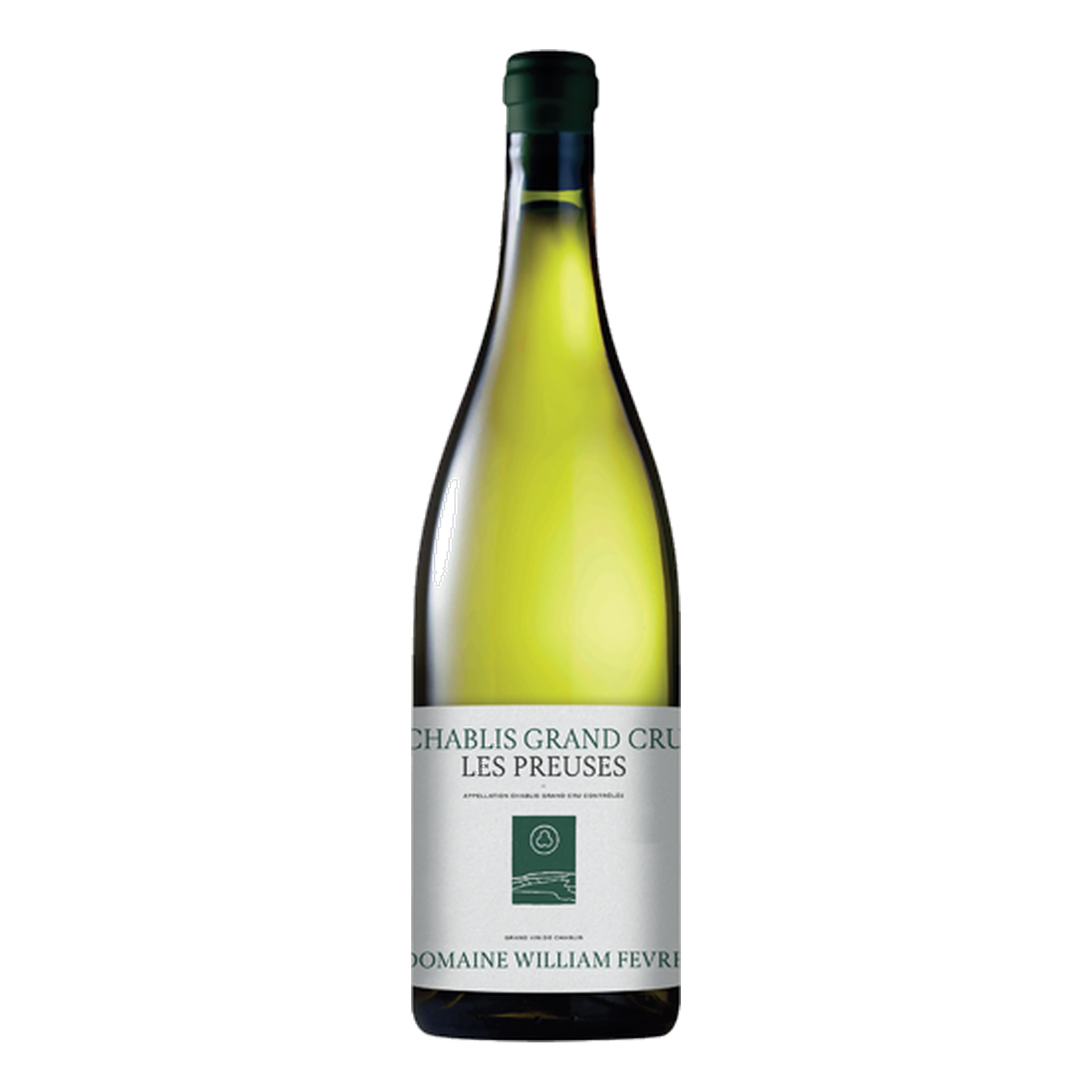
Domaine William Fevre
Domaine William Fèvre Chablis Grand Cru Les Preuses Domaine 2023
Domaine William Fèvre Chablis Grand Cru Les Preuses Domaine 2023
Couldn't load pickup availability
Description
Description
Domaine William Fèvre Chablis Grand Cru Les Preuses Domaine comes from the grand cru climat that sits highest and furthest west on the Chablis hill.
Preuses lies between Bougros and Vaudésir, near the top of the slope, on ground that is notably calcareous even by the standards of a region built on Kimmeridgian marl. It is generally reckoned the most open and generous of the grands crus in its youth, without giving up the length that the hill is known for. The domaine was founded in 1959 by William Fèvre, whose family had long farmed vines here, and was bought in 1998 by the Henriot family, who installed Didier Séguier as winemaker. He steered the house away from the heavy new oak used in the past, towards larger and older barrels. The Domaine designation marks wine from the estate's own vines.
Serve at about 12 degrees with lobster, scallops or roast poultry; it will keep and improve for well over a decade.
*Every effort is made to ensure the current vintage is accurate; however, variations can occur. If you are after a specific vintage, please contact us prior to ordering.
Wine Details
Wine Details
Type: White Wine
Style: Full-bodied, dry
Grape Varietal: Chardonnay
Tastes Like: A Chablis Grand Cru: Chardonnay with more depth and weight than village Chablis, while staying taut and fresh, with only older oak
Alcohol Percentage: 13%
Closure: Cork
Size: 750mL
Appellation: Chablis Grand Cru AOC (Appellation d'Origine Contrôlée: France's protected designation of origin; Grand Cru is the top tier of Chablis' vineyard classification: seven named vineyards on a single slope above the town)
Region: Chablis, Burgundy, France
Terroir: Les Preuses, 11.44 hectares high on the Côte des Grands Crus, uphill from Bougros on the western side of the Grands Crus. The domaine owns 2.55 hectares, about 22% of the climat. Its northernmost plots face south-west, the rest south to south-east, on dense, compact clay over a slab of limestone
Aging: Gentle pneumatic pressing and natural fermentation in stainless steel; about 19 months in total, with around 35% of the wine spending 5 to 6 months on fine lees in French oak barrels (no new oak), then finished in small stainless steel tanks
Serving Temperature: 12-13°C
Winery
Winery
Domaine William Fèvre is one of the great names of Chablis. The Fèvre family has been part of Chablis life for more than 250 years, and William Fèvre declared the domaine's first vintage in the late 1950s, then bought parcels in many of the appellation's best Premiers and Grands Crus. In 1998 he sold the domaine to the Henriot family of Champagne, and Didier Séguier, who arrived that year, has run the vineyards and cellar ever since. After a period within the Artémis Domaines group, the domaine became part of Domaines Barons de Rothschild (Lafite) in January 2024, the group's first estate in Burgundy. Today it works about 90 parcels, including 15.9 hectares of Premier Cru and 15.2 hectares of Grand Cru, one of the largest grand cru holdings in Chablis. The vineyards have been farmed organically since 2000, with certification from the 2023 vintage. In the cellar the grapes are moved by gravity and pressed gently, fermentations start naturally, and the wines are raised in stainless steel, with a share in French oak barrels but no new oak.
The 2023 Les Preuses is the first vintage from certified organic vines. After a mild, dry winter, April frosts did no major harm and May was hot and dry; June storms brought disease pressure that had to be managed closely, and a dry August slowed ripening. Picking began in early September in the heat, with generous volumes and grapes in excellent health. Its dense clay and limestone soils give a wine built to develop over many years.
Food Pairings
Food Pairings
Soups: Jerusalem artichoke or cauliflower velouté
Fish: Snapper with brown butter, hazelnuts and capers
Shellfish: Scampi grilled in the shell
Vegetarian: Leek and gruyère gratin
Cheese Pairings
Cheese Pairings
Saint-Florentin: A soft washed-rind cheese from the town near Chablis, a true local match
Coulommiers: Creamy, mild cousin of Brie, gentle with a fine white
Ossau-Iraty: Basque sheep's cheese, nutty and smooth
Comté (24 months): Deep and nutty, a long-standing Chablis partner
Recipe
Recipe
Velouté de Topinambours aux Noisettes (Jerusalem Artichoke Soup with Hazelnuts)
Ingredients (Serves 4 to 6):
- 800g Jerusalem artichokes, scrubbed or peeled, sliced (drop into water with a squeeze of lemon as you go)
- 40g butter
- 1 brown onion and 1 leek (white part), sliced
- 1 potato, peeled and diced
- 1L vegetable or chicken stock
- 150mL pouring cream
- 50g hazelnuts, toasted, skinned and roughly chopped
- A little hazelnut oil or extra virgin olive oil, to finish
- Chopped chives, salt and white pepper
Instructions:
- Melt the butter in a large saucepan and cook the onion and leek gently for 10 minutes until soft but not coloured.
- Add the drained artichokes and potato and stir for 3 minutes.
- Pour in the stock, bring to the boil and simmer for 25 minutes until everything is very tender.
- Blend until completely smooth, then stir in the cream and reheat gently. Season with salt and white pepper, and thin with a little stock if needed.
- Serve in warm bowls topped with toasted hazelnuts, chives and a few drops of hazelnut oil.
Velouté de topinambours is a French autumn and winter classic, a silky soup made from the knobbly Jerusalem artichoke, whose gentle, nutty sweetness has made it a bistro favourite again. The creamy texture and toasted hazelnuts suit a Grand Cru Chablis like Les Preuses, whose depth matches the cream while its freshness keeps the soup from feeling heavy.