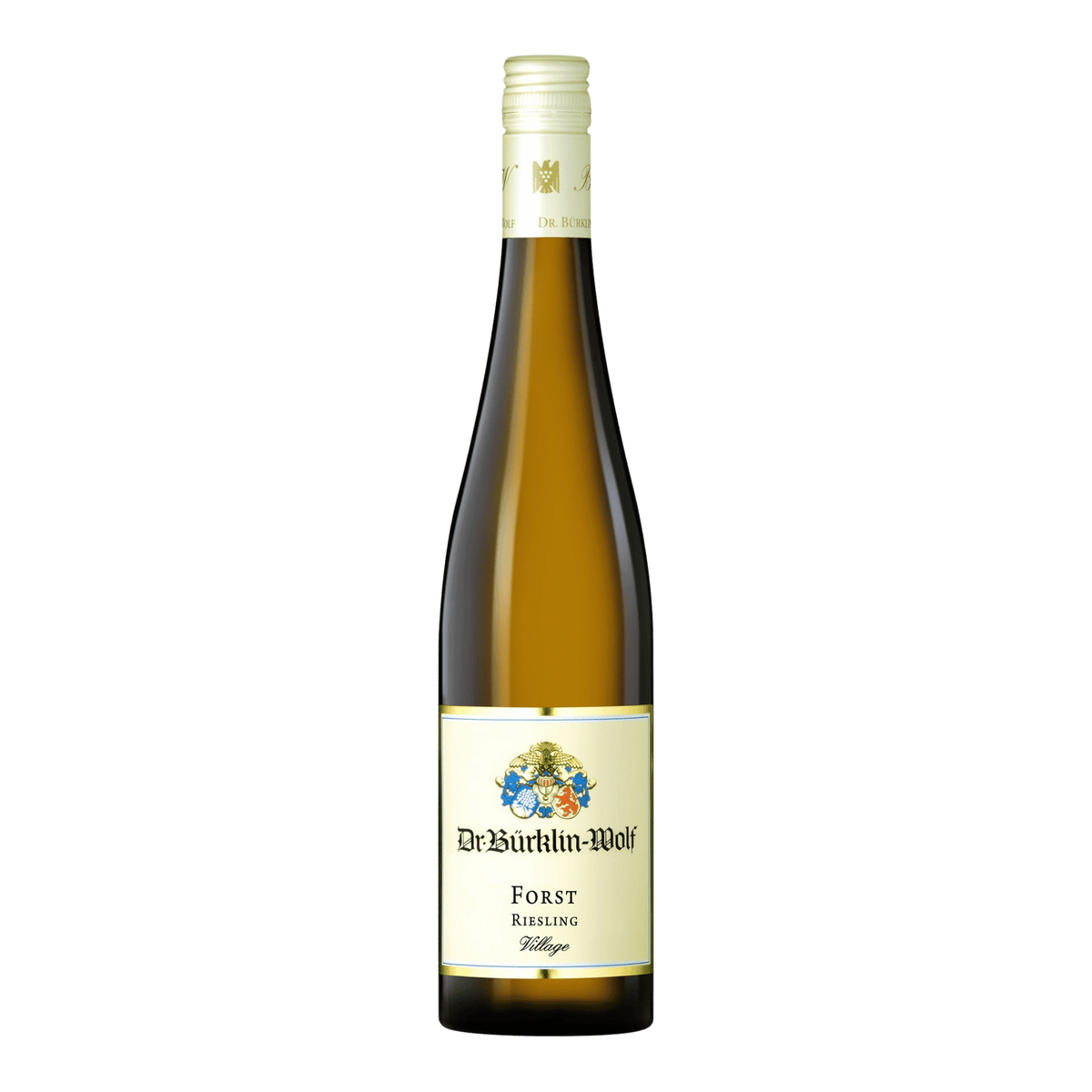
Dr. Bürklin-Wolf
Dr. Bürklin-Wolf Forst Riesling 2023
Dr. Bürklin-Wolf Forst Riesling 2023
Couldn't load pickup availability
Description
Description
Dr. Bürklin-Wolf Forst Riesling is a dry village wine built from declassified grand cru fruit in the Pfalz's most famous commune.
Forst is the smallest and most celebrated of the Mittelhaardt villages, and its reputation rests on basalt: a quarry above the village supplied dark volcanic rock that growers spread over the sandstone and loam vineyards for warmth and mineral content. Dr. Bürklin-Wolf owns parcels in the classified Kirchenstück, Jesuitengarten, Pechstein and Ungeheuer, and this village bottling is made from fruit declassified out of those Grosse Lage sites along with younger vines. The estate has farmed biodynamically since the early 2000s under Demeter certification. Hand-picked grapes are whole-bunch pressed, fermented with indigenous yeasts in stainless steel and large old oak, and left on fine lees before a dry bottling under screwcap.
Dry, firm and stony, with more grip than a typical village wine; serve at 10 to 12 degrees with roast pork, veal, or firm cheeses.
*Every effort is made to ensure the current vintage is accurate; however, variations can occur. If you are after a specific vintage, please contact us prior to ordering.
Wine Details
Wine Details
Type: White Wine
Style: Dry (trocken)
Grape Varietal: Riesling
Tastes Like: A dry German village Riesling from the Mittelhaardt in the Pfalz
Alcohol Percentage: 12%
Closure: Screwcap
Size: 750mL
Appellation: Qualitätswein Pfalz (Germany's quality wine category: grapes from one named wine region, here the Pfalz, made to that category's rules); in the estate's own four-tier ranking (Estate, Village, Premier Cru, Grand Cru) this is a Village wine, made from vineyards around one village, here Forst
Region: Forst, Mittelhaardt, Pfalz, Germany
Terroir: Young vines, about 10 years old, in two of Forst's Grand Cru sites: 50% Jesuitengarten and 50% Pechstein
Aging: Fermented with natural yeasts; about 6 months on lees, the estate's usual time for its village wines
Serving Temperature: 8-10°C
Winery
Winery
Dr. Bürklin-Wolf in Wachenheim, in the Pfalz, traces its history to 1597, and Bernhard Bürklin, town clerk and later mayor of Wachenheim, began the family's winegrowing there. The estate took its double name in 1875, when Luise Wolf married Dr. Albert Bürklin and brought the Wolf family's vineyards in Wachenheim, Forst, Deidesheim and Ruppertsberg into the estate. Bettina Bürklin-von Guradze took over in 1990, and today the estate farms about 85 hectares in the Mittelhaardt, making it one of Germany's largest family-owned wine estates. It was among the first in Germany to rank its vineyards on the Burgundian model, from the estate wine through village wines to Premier Cru (P.C.) and Grand Cru (G.C.), with its top sites matching those rated highest in the Royal Bavarian vineyard classification of 1828. The whole estate has been farmed biodynamically since 2005, certified by Biodyvin and as organic, and the Rieslings ferment with their own natural yeasts, the single-vineyard wines in large old oak casks.
Forst is home to several of the estate's Grand Cru vineyards, and this Village Riesling comes entirely from young vines in two of them: half from the Jesuitengarten and half from the Pechstein. The vines are about ten years old, and their grapes go into this village wine while they mature; the Jesuitengarten parcel was replanted in 2015 and is not yet back to Grand Cru standard. The wine ferments with its own yeasts and is bottled under screwcap. The 2023 is bone dry, with 1.0 g/L of residual sugar, at 12% alcohol. Open it as an affordable way into two of Forst's most famous vineyard names, and as a dry Riesling for the table while the estate's Grand Crus age.
Food Pairings
Food Pairings
Poultry: Roast spatchcock with lemon, thyme and garlic
Shellfish: Grilled king prawns with garlic butter and crusty bread
Veal: Wiener schnitzel with a potato and cucumber salad
Vegetarian: Mushroom and leek quiche with a green salad
Cheese Pairings
Cheese Pairings
Allgäuer Bergkäse (young): A firm mountain cheese from the Allgäu with good fat and salt; a bone-dry Riesling's acidity cleans the palate between bites
Limburger: A soft washed-rind cheese with a strong rind; the wine's acidity and moderate alcohol reset the palate after its salty paste
Comté (12 months): A firm Jura cheese with a dense, smooth texture that suits a dry wine of medium weight
Recipe
Recipe
Badisches Schäufele mit Brägele (Baden Cured and Smoked Pork Shoulder with Baden Fried Potatoes)
Ingredients (Serves 4):
- 1 cured and smoked pork shoulder on the bone (Schäufele), about 1.5 kg (order from a German butcher, or use a smoked pork collar)
- 1 onion, studded with 2 cloves
- 1 carrot and 1 small leek, roughly chopped
- 1 bay leaf, 5 black peppercorns and 4 juniper berries
- 1 kg waxy potatoes, boiled in their skins the day before
- 100 g Speck or smoked bacon, diced
- 1 onion, thinly sliced
- 3 tbsp lard or clarified butter
- 2 tbsp chopped chives or parsley
- Salt and black pepper
- Hot mustard and grated horseradish, to serve
Instructions:
- Put the Schäufele in a large pot with the clove-studded onion, carrot, leek, bay leaf, peppercorns and juniper, and cover with cold water.
- Heat slowly until the water is barely trembling (about 85°C). Do not let it boil, or the meat will toughen. Cook for 1½-2 hours, until a skewer slides in easily.
- Meanwhile, peel the cold potatoes and slice them thinly.
- Heat the lard in a large cast-iron or heavy frying pan over medium-high heat. Add the potatoes in a single layer and fry for 15-20 minutes, turning only every few minutes, until golden and crisp.
- Add the Speck and sliced onion for the last 5 minutes, season with salt and pepper and scatter with chives.
- Lift the Schäufele from the pot, remove the rind and slice the meat against the grain.
- Serve the slices with the Brägele, mustard, horseradish and a green salad.
Schäufele takes its name from the shoulder blade (Schaufel, a small shovel) that runs through the cut, and it is a Sunday and feast-day dish in Baden, across the Rhine from the Pfalz, always served with Brägele, the region's thinly sliced fried potatoes. The cured pork brings salt and the potatoes bring fat, so a bone-dry Riesling is the natural partner: with 1.0 g/L of sugar, firm acidity and 12% alcohol, this Forst village wine cuts through both and leaves the palate ready for the next mouthful.