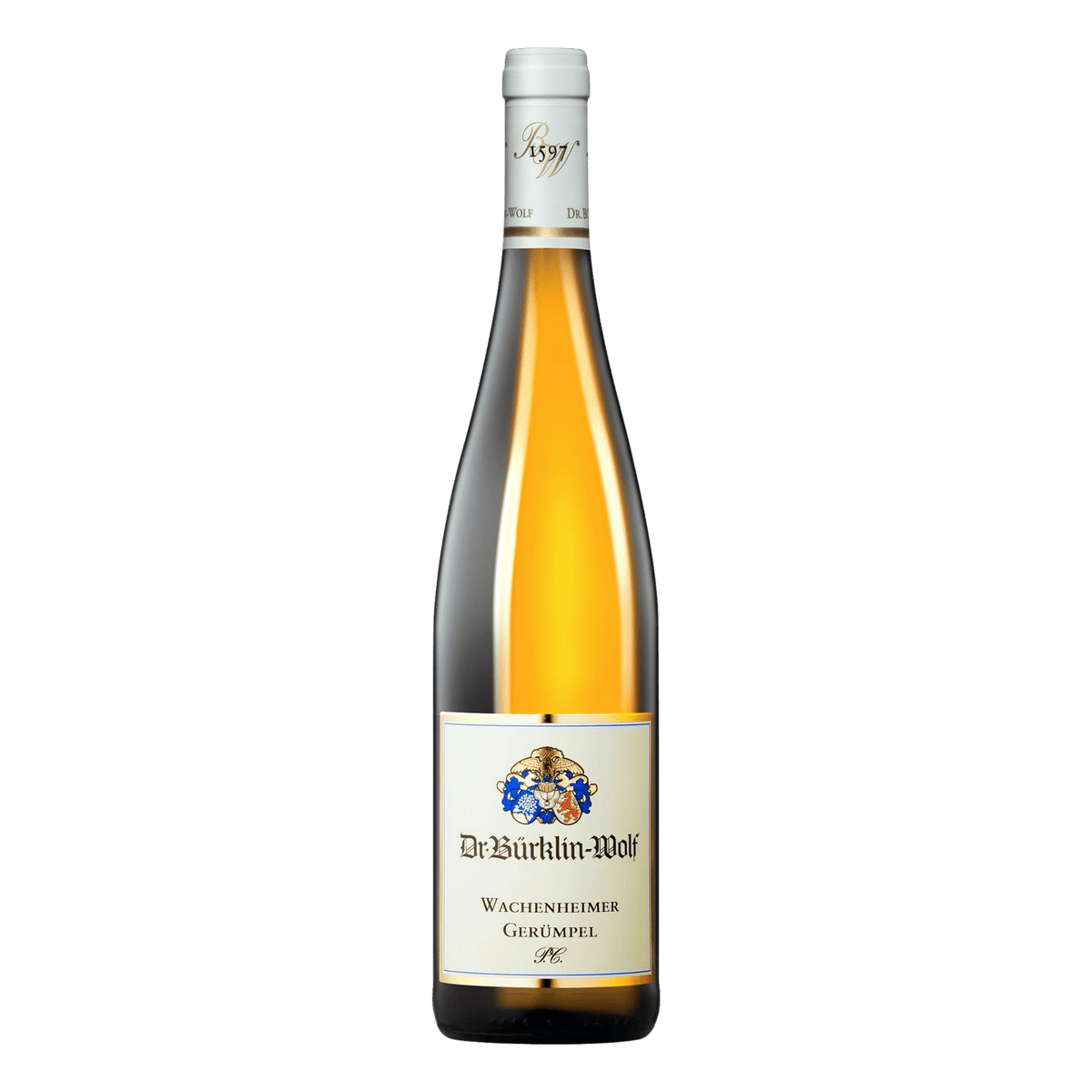
Dr. Bürklin-Wolf
Dr. Bürklin-Wolf Gerümpel Riesling 2020
Dr. Bürklin-Wolf Gerümpel Riesling 2020
Couldn't load pickup availability
Description
Description
Dr. Bürklin-Wolf Gerümpel Riesling comes from one of Wachenheim's classified Erste Lage sites, bottled under the estate's own P.C. designation.
Dr. Bürklin-Wolf classifies its vineyards on a Burgundian model, with P.C. standing for Premier Cru and G.C. for Grand Cru, a system reintroduced from the estate's own nineteenth-century records. Gerümpel sits on the slope above Wachenheim on weathered sandstone mixed with limestone and clay, a warm site that ripens reliably and gives a Riesling with breadth as well as tension. The vines are farmed biodynamically under Demeter certification, with composts and plant preparations replacing systemic treatments. The grapes are hand-harvested, whole-bunch pressed and fermented with wild yeasts, largely in large old oak Stückfass, then left on fine lees for several months before a dry bottling.
Dry and structured, with the flesh Wachenheim tends to give; serve at 11 to 12 degrees with roast poultry, veal, or richer fish dishes.
*Every effort is made to ensure the current vintage is accurate; however, variations can occur. If you are after a specific vintage, please contact us prior to ordering.
Wine Details
Wine Details
Type: White Wine
Style: Dry (trocken)
Grape Varietal: Riesling
Tastes Like: A dry German Riesling from a Premier Cru-rated single vineyard in the Pfalz
Alcohol Percentage: 12.5%
Size: 750mL
Appellation: Qualitätswein Pfalz (Germany's quality wine category: grapes from one named wine region, here the Pfalz, made to that category's rules); the estate ranks the Wachenheimer Gerümpel Premier Cru (P.C.), the second-highest of its four tiers (Estate, Village, Premier Cru, Grand Cru), one step below its Grand Cru vineyards
Region: Wachenheim, Mittelhaardt, Pfalz, Germany
Terroir: The Gerümpel, one of the estate's five Premier Cru vineyards in its home village of Wachenheim; farmed biodynamically
Aging: Fermented with natural yeasts in large old oak casks; the estate gives its P.C. wines about 12 months on lees
Serving Temperature: 10-12°C
Winery
Winery
Dr. Bürklin-Wolf in Wachenheim, in the Pfalz, traces its history to 1597, and Bernhard Bürklin, town clerk and later mayor of Wachenheim, began the family's winegrowing there. The estate took its double name in 1875, when Luise Wolf married Dr. Albert Bürklin and brought the Wolf family's vineyards in Wachenheim, Forst, Deidesheim and Ruppertsberg into the estate. Bettina Bürklin-von Guradze took over in 1990, and today the estate farms about 85 hectares in the Mittelhaardt, making it one of Germany's largest family-owned wine estates. It was among the first in Germany to rank its vineyards on the Burgundian model, from the estate wine through village wines to Premier Cru (P.C.) and Grand Cru (G.C.), with its top sites matching those rated highest in the Royal Bavarian vineyard classification of 1828. The whole estate has been farmed biodynamically since 2005, certified by Biodyvin and as organic, and the Rieslings ferment with their own natural yeasts, the single-vineyard wines in large old oak casks.
The Gerümpel is one of five Wachenheim vineyards the estate ranks Premier Cru, the tier just below its Grand Crus, and the estate's home village gives its name to the wine: Wachenheimer Gerümpel. Like all of the estate's single-vineyard wines, it ferments with its own yeasts in large old oak casks, and the estate gives its P.C. wines about twelve months on their lees. The 2020 is dry, with under 3 g/L of residual sugar and 8.8 g/L of acidity, at 12.5% alcohol. With six years since harvest, this is a chance to drink a single-vineyard Pfalz Riesling with some bottle age: open it with a slow-cooked dinner and give it a little air in a large glass.
Food Pairings
Food Pairings
Game: Venison medallions with juniper sauce and celeriac purée
Veal: Veal cutlets with chanterelles and buttered egg noodles
Fish: Baked snapper with brown butter, capers and boiled potatoes
Poultry: Roast duck breast with braised witlof
Cheese Pairings
Cheese Pairings
Allgäuer Bergkäse (12 months): A firm mountain cheese from the Allgäu, dense and salty enough to meet a dry Riesling with some bottle age
Gruyère: A firm Swiss cheese with a close, slightly crystalline texture; the wine's high acidity cuts its fat
Aged Gouda: Hard, crunchy and concentrated; a dry wine with 8.8 g/L of acidity keeps the pairing from feeling heavy
Recipe
Recipe
Rinderrouladen mit Kartoffelpüree (Braised Beef Rolls with Mustard, Bacon and Gherkin, and Mashed Potato)
Ingredients (Serves 4):
- 4 thin slices beef topside (about 180 g each), beaten out to 5 mm
- 4 tsp hot German mustard (or Dijon)
- 8 rashers streaky bacon
- 2 onions: 1 thinly sliced, 1 diced
- 4 small gherkins (Gewürzgurken), quartered lengthways
- 2 tbsp vegetable oil or lard
- 1 carrot and ¼ celeriac, diced
- 1 tbsp tomato paste
- 125 mL dry white wine (a splash of a dry Riesling)
- 500 mL beef stock and 1 bay leaf
- 1 tbsp cornflour mixed with 2 tbsp cold water
- 1 kg floury potatoes, 60 g butter and 200 mL warm milk, for the mash
- Salt, black pepper and a pinch of nutmeg
Instructions:
- Lay the beef slices flat, season lightly with salt and pepper and spread each with 1 tsp mustard.
- Cover each slice with 2 rashers of bacon, a quarter of the sliced onion and 4 pieces of gherkin. Fold in the long sides, roll up tightly from the short end and secure with toothpicks or kitchen string.
- Heat the oil in a heavy casserole over medium-high heat and brown the rolls well on all sides, about 8 minutes. Set aside.
- Add the diced onion, carrot and celeriac to the pan and cook for 5 minutes until browned. Stir in the tomato paste for 1 minute.
- Pour in the wine and scrape up the browned bits, then add the stock and bay leaf. Return the rolls, cover and simmer gently for 1½ hours, turning once, until tender.
- Meanwhile, boil the potatoes in salted water until tender, drain, and mash with the butter, warm milk, salt and nutmeg.
- Lift out the rolls and remove the string. Strain the sauce (or leave the vegetables in for a rustic style), bring to the boil and thicken with the cornflour mixture. Season to taste.
- Serve the Rouladen with the gravy spooned over and the mash alongside.
Rinderrouladen are a Sunday dinner in family kitchens across Germany, and every household has its own version of the mustard, bacon, onion and gherkin filling. Here they are braised in stock with a splash of dry white wine, which keeps the sauce in step with a white wine at the table. The bacon and gherkin bring salt and vinegar and the gravy brings richness, so the dish needs a wine with structure: a dry Premier Cru Riesling at 12.5% alcohol, with a few years of age behind it, has the weight to stand beside braised beef and the acidity to cut through it.