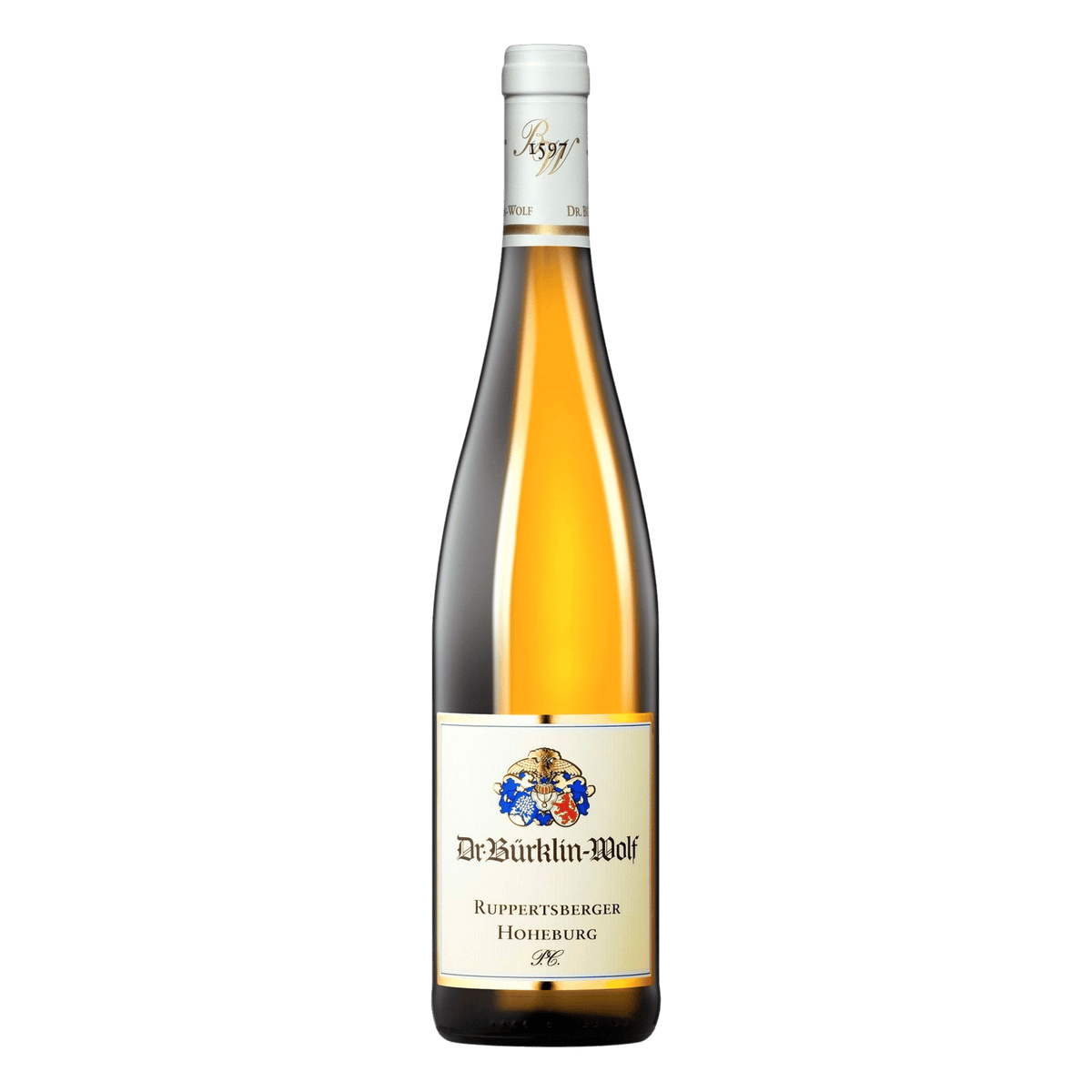
Dr. Bürklin-Wolf
Dr. Bürklin-Wolf Hoheburg Riesling 2022
Dr. Bürklin-Wolf Hoheburg Riesling 2022
Couldn't load pickup availability
Description
Description
Dr. Bürklin-Wolf Hoheburg Riesling is an Erste Lage from Ruppertsberg, classified P.C. by the estate.
Hoheburg lies on the Ruppertsberg slope at the southern end of Dr. Bürklin-Wolf's holdings, on limestone-influenced soils over weathered sandstone with a covering of loam. Ruppertsberg's wines are typically a little finer boned and more overtly mineral than those of Forst or Wachenheim to the north, and Hoheburg is among the cooler parcels. The estate has farmed the whole domaine biodynamically under Demeter certification since the early 2000s, using composts and plant preparations in place of herbicides. Grapes are hand-picked, whole-bunch pressed and fermented with indigenous yeasts, largely in large old oak Stückfass, and the wine rests on fine lees before being bottled dry with a DIAM closure.
Dry, fine and saline, with length rather than weight; serve at 11 to 12 degrees with shellfish, white fish, or roast chicken.
*Every effort is made to ensure the current vintage is accurate; however, variations can occur. If you are after a specific vintage, please contact us prior to ordering.
Wine Details
Wine Details
Type: White Wine
Style: Dry (trocken)
Grape Varietal: Riesling
Tastes Like: A dry German Riesling from a Premier Cru-rated single vineyard in the Pfalz
Alcohol Percentage: 12%
Size: 750mL
Appellation: Qualitätswein Pfalz (Germany's quality wine category: grapes from one named wine region, here the Pfalz, made to that category's rules); the estate ranks the Ruppertsberger Hoheburg Premier Cru (P.C.), the second-highest of its four tiers (Estate, Village, Premier Cru, Grand Cru), one step below its Grand Cru vineyards
Region: Ruppertsberg, Mittelhaardt, Pfalz, Germany
Terroir: The Hoheburg, the estate's only Premier Cru vineyard in Ruppertsberg; vines planted in 1975; the soil is described as deep, sandy loam with volcanic rock mixed in
Aging: Wild-fermented in large neutral oak casks; the estate gives its P.C. wines about 12 months on lees
Serving Temperature: 10-12°C
Winery
Winery
Dr. Bürklin-Wolf in Wachenheim, in the Pfalz, traces its history to 1597, and Bernhard Bürklin, town clerk and later mayor of Wachenheim, began the family's winegrowing there. The estate took its double name in 1875, when Luise Wolf married Dr. Albert Bürklin and brought the Wolf family's vineyards in Wachenheim, Forst, Deidesheim and Ruppertsberg into the estate. Bettina Bürklin-von Guradze took over in 1990, and today the estate farms about 85 hectares in the Mittelhaardt, making it one of Germany's largest family-owned wine estates. It was among the first in Germany to rank its vineyards on the Burgundian model, from the estate wine through village wines to Premier Cru (P.C.) and Grand Cru (G.C.), with its top sites matching those rated highest in the Royal Bavarian vineyard classification of 1828. The whole estate has been farmed biodynamically since 2005, certified by Biodyvin and as organic, and the Rieslings ferment with their own natural yeasts, the single-vineyard wines in large old oak casks.
The Hoheburg is the estate's one Premier Cru vineyard in Ruppertsberg; its other five P.C. sites all lie in Wachenheim. The vines were planted in 1975, so they are now around fifty years old, and the soil is described as deep, sandy loam with volcanic rock mixed in. The 2022 was fermented with its own yeasts in large neutral oak casks, and the estate gives its P.C. wines about twelve months on their lees. It is dry, at 12% alcohol. Open it with shellfish, fish and summer cooking, or alongside the Gaisböhl G.C. from the same village to compare two of Ruppertsberg's best sites.
Food Pairings
Food Pairings
Shellfish: Grilled Moreton Bay bugs with lemon butter
Fish: Barramundi fillets with beurre blanc and steamed greens
Poultry: Chicken in a creamy tarragon sauce with rice
Summer vegetables: Zucchini, ricotta and herb tart
Cheese Pairings
Cheese Pairings
Butterkäse: A soft, supple German cow's milk cheese; the wine's dry finish and acidity keep its creaminess in check
Brie de Meaux: Rich and soft, with a bloomy rind; a dry Premier Cru Riesling has the acidity to cut through its fat
Fresh chèvre: A young, soft goat's cheese with lively acidity that suits a dry Riesling of moderate alcohol
Recipe
Recipe
Flusskrebse im Dillsud (Freshwater Crayfish Boiled in a Dill and Caraway Brine, with Bread and Dill Butter)
Ingredients (Serves 4):
- 2 kg live yabbies (about 24-32), or 8 marron
- 4 L water
- 60 g (about 3 tbsp) salt
- 1 tbsp caraway seeds
- 1 large bunch dill, stalks and fronds separated (flowering heads if you can find them)
- 1 onion, quartered, and 1 bay leaf
- 1 tsp sugar
- 125 mL dry white wine (optional)
- 125 g butter, softened
- ½ tsp finely grated lemon zest
- Crusty white bread or rye bread, and lemon wedges, to serve
Instructions:
- Place the live yabbies or marron in the freezer for 20-30 minutes until they are completely still; this is the humane way to prepare them.
- In a large pot, bring the water to the boil with the salt, caraway, dill stalks, onion, bay leaf, sugar and wine. Boil for 10 minutes to make the brine (Sud).
- Add the yabbies in batches so the water stays at the boil. Cook for 4-6 minutes (marron 8-10 minutes, depending on size) until bright red.
- Take the pot off the heat, return all the yabbies and leave them to steep in the brine for 10 minutes.
- Meanwhile, chop 3 tbsp of the dill fronds and mash them into the softened butter with the lemon zest and a pinch of salt.
- Lift the yabbies onto a large platter with a little of the brine and scatter with the remaining dill fronds.
- To eat, twist off the tail, crack the shell along the underside, lift out the meat and pull away the dark vein. Crack the claws for the meat inside.
- Serve with bread spread thickly with dill butter, lemon wedges, finger bowls and plenty of napkins.
Crayfish cooked in a dill brine are an old summer dish in Germany and around the Baltic, eaten slowly at the table with bread, butter and a cold glass of white wine. In Australia, yabbies or marron are the natural stand-ins for the European river crayfish. Delicate shellfish, salty brine and butter call for a wine that is dry, with good acidity and no excess weight: this Hoheburg Premier Cru Riesling, at 12% alcohol, cuts the butter and matches the salt of the brine without overwhelming the yabbies.