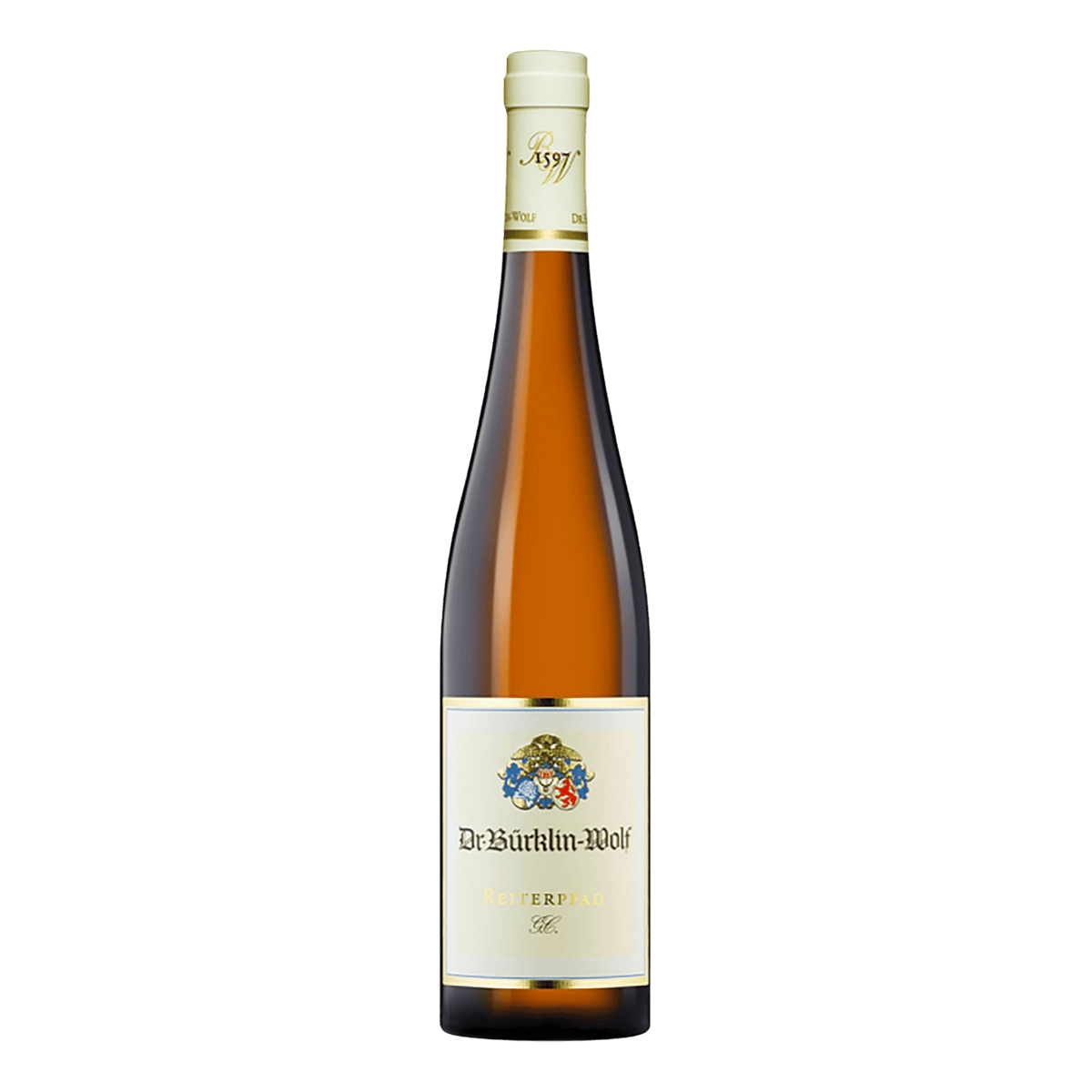
Dr. Bürklin-Wolf
Dr. Bürklin-Wolf Reiterpfad Riesling 2021
Dr. Bürklin-Wolf Reiterpfad Riesling 2021
Couldn't load pickup availability
Description
Description
Dr. Bürklin-Wolf Reiterpfad Riesling is a Grand Cru bottling from one of the Mittelhaardt's largest and best known slopes.
Reiterpfad runs along the Ruppertsberg hillside on sandy loam over limestone and weathered sandstone, a broad site of which only certain historic parcels are ranked at the top level. Dr. Bürklin-Wolf classifies its holding G.C., the estate's Grand Cru tier, within the Burgundian-style hierarchy it revived from nineteenth-century vineyard records. The warm, free-draining soils give a Riesling with ripe stone-fruit weight held in check by the limestone beneath. The estate has farmed biodynamically under Demeter certification since the early 2000s. Grapes are hand-picked, whole-bunch pressed and fermented with indigenous yeasts in large neutral oak, then matured on fine lees for many months before being bottled dry.
Dry, broad-shouldered and mineral, and best given a few years in bottle; serve at around 12 degrees with roast pork, veal, or lobster.
*Every effort is made to ensure the current vintage is accurate; however, variations can occur. If you are after a specific vintage, please contact us prior to ordering.
Wine Details
Wine Details
Type: White Wine
Style: Dry (trocken)
Grape Varietal: Riesling
Tastes Like: A dry German Riesling from a top single vineyard (German Grand Cru) in the Pfalz
Alcohol Percentage: 12.5%
Size: 750mL
Appellation: Qualitätswein Pfalz (Germany's quality wine category: grapes from one named wine region, here the Pfalz, made to that category's rules); the estate ranks the Ruppertsberger Reiterpfad Grand Cru (G.C.), the top of its four tiers (Estate, Village, Premier Cru, Grand Cru), kept for its best single vineyards
Region: Ruppertsberg, Mittelhaardt, Pfalz, Germany
Terroir: The Reiterpfad in Ruppertsberg; the estate holds 0.83 ha, replanted in 2004; layered sandstone and limestone
Aging: Fermented with natural yeasts and matured in large old oak casks (Doppelstück), usually until the April of the second year after harvest; the estate gives its G.C. wines up to 18 months on lees
Serving Temperature: 10-12°C
Winery
Winery
Dr. Bürklin-Wolf in Wachenheim, in the Pfalz, traces its history to 1597, and Bernhard Bürklin, town clerk and later mayor of Wachenheim, began the family's winegrowing there. The estate took its double name in 1875, when Luise Wolf married Dr. Albert Bürklin and brought the Wolf family's vineyards in Wachenheim, Forst, Deidesheim and Ruppertsberg into the estate. Bettina Bürklin-von Guradze took over in 1990, and today the estate farms about 85 hectares in the Mittelhaardt, making it one of Germany's largest family-owned wine estates. It was among the first in Germany to rank its vineyards on the Burgundian model, from the estate wine through village wines to Premier Cru (P.C.) and Grand Cru (G.C.), with its top sites matching those rated highest in the Royal Bavarian vineyard classification of 1828. The whole estate has been farmed biodynamically since 2005, certified by Biodyvin and as organic, and the Rieslings ferment with their own natural yeasts, the single-vineyard wines in large old oak casks.
The Reiterpfad is one of the estate's two Grand Cru vineyards in Ruppertsberg, alongside the Gaisböhl monopole. The estate's 0.83 hectare holding was replanted in 2004, on soils of layered sandstone and limestone. The wine ferments with its own yeasts and matures in large old Doppelstück casks, usually until the April of the second year after harvest, with long time on its lees. The 2021 is dry, with 1.0 g/L of residual sugar, at 12.5% alcohol. Five years from harvest, it is a Grand Cru to open now with grilled meats and outdoor cooking, or to set against the Gaisböhl for a lesson in two Ruppertsberg sites.
Food Pairings
Food Pairings
Barbecue: Grilled lamb cutlets with a parsley and caper salsa verde
Poultry: Coq au Riesling with mushrooms and buttered noodles
Fish: Grilled salmon with a sorrel cream sauce
Vegetarian: Leek and Gruyère tart with a radicchio salad
Cheese Pairings
Cheese Pairings
Romadur: A soft Bavarian washed-rind cheese, supple and salty; a dry Grand Cru has the acidity to clean the palate after it
Gruyère (aged): A firm Swiss cheese with a dense texture, well matched to a dry Riesling with five years of age
Brie de Meaux: Soft, rich and creamy; the wine's acidity and 12.5% alcohol give it enough weight to cut the fat
Recipe
Recipe
Thüringer Rostbrätel (Thuringian Mustard-Marinated Grilled Pork Neck Steaks with Onions and Rye Bread)
Ingredients (Serves 4):
- 4 pork neck (scotch fillet) steaks, about 200 g each and 2 cm thick
- 3 large onions, sliced into rings
- 3 tbsp medium-hot German mustard
- 2 tbsp vegetable oil
- 2 garlic cloves, crushed
- 1 tsp dried marjoram
- 1 tsp coarsely ground black pepper
- 125 mL pale lager, for brushing (optional, but traditional)
- 20 g butter
- 8 slices dark rye bread
- Salt, and extra mustard to serve
Instructions:
- Mix the mustard, oil, garlic, marjoram and pepper. Coat the steaks all over.
- Layer the steaks in a dish with half the onion rings, cover and refrigerate for at least 12 hours, ideally 24.
- Light a charcoal grill or heat a barbecue to medium-high. Take the steaks out of the fridge 30 minutes before cooking.
- Scrape the onions off the steaks and set them aside. Grill the steaks for 5-6 minutes each side, brushing occasionally with a little lager, until cooked through with good char marks.
- Meanwhile, fry the marinade onions and the remaining onion rings in the butter over medium heat for 10-12 minutes until soft and golden.
- Salt the steaks only after grilling, then rest them for 3 minutes.
- Serve each steak with a heap of onions, rye bread and more mustard on the side.
Rostbrätel is the grill classic of Thuringia in central Germany, cooked over charcoal at markets and festivals beside the region's famous Rostbratwurst and always served with onions and bread. It is usually drunk with beer, but the fat of the pork neck and the salt of the mustard marinade need acidity, and a dry Grand Cru Riesling at 12.5% alcohol, with 1.0 g/L of sugar, has the weight to stand up to grilled meat and the acidity to cut through it.