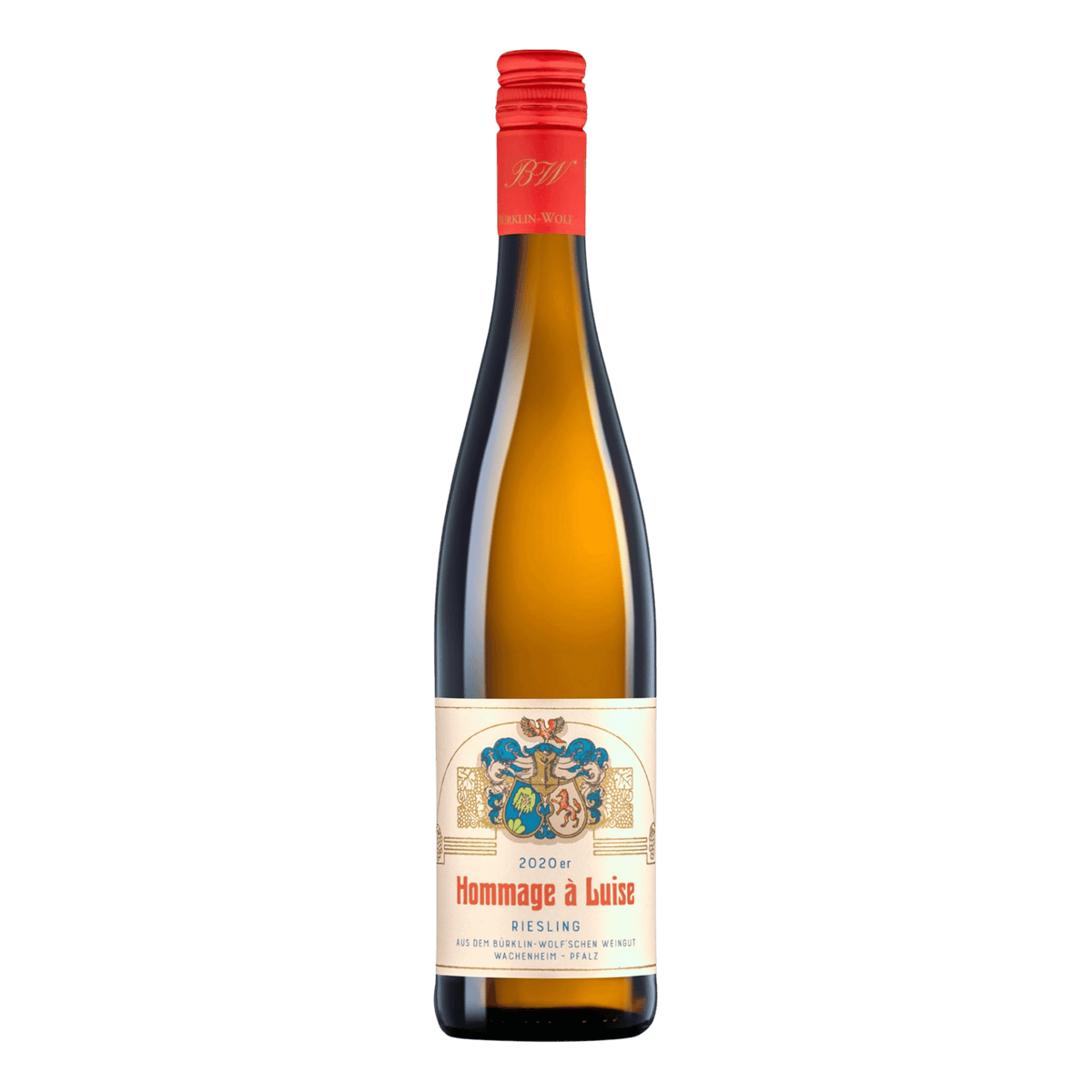
Dr. Bürklin-Wolf
Dr. Bürklin-Wolf Riesling Hommage à Luise Kabinett Style 2023
Dr. Bürklin-Wolf Riesling Hommage à Luise Kabinett Style 2023
Couldn't load pickup availability
Description
Description
Dr. Bürklin-Wolf Riesling Hommage à Luise is an off-dry, low-alcohol Riesling made in the old Kabinett manner and named for a figure in the estate's family history.
This cuvée is deliberately picked earlier and lower in potential alcohol than the estate's dry range, finishing at around 9.5 per cent with roughly 35.6 grams per litre of residual sugar, a balance far closer to a classical Pfalz Kabinett than to a modern trocken bottling. The fruit comes from Dr. Bürklin-Wolf's biodynamically farmed parcels in the Mittelhaardt around Wachenheim, on weathered sandstone and loam. The estate has worked biodynamically since the early 2000s and holds Demeter certification. Fermentation runs on ambient yeasts and is stopped while sugar still remains, and the wine goes to bottle early under screwcap to keep its freshness and its low-alcohol delicacy intact.
Light, gently sweet and refreshing rather than rich; serve at 8 to 10 degrees with spiced food, charcuterie, or as an aperitif.
*Every effort is made to ensure the current vintage is accurate; however, variations can occur. If you are after a specific vintage, please contact us prior to ordering.
Wine Details
Wine Details
Type: White Wine
Style: Off-dry (feinherb, Kabinett style)
Grape Varietal: Riesling
Tastes Like: A light, off-dry German Riesling in the Kabinett style
Alcohol Percentage: 9%
Closure: Screwcap
Size: 750mL
Appellation: Qualitätswein Pfalz (Germany's quality wine category: grapes from one named wine region, here the Pfalz, made to that category's rules); an Estate (Gutswein) tier wine in the estate's four-tier ranking, so the label does not carry the word Kabinett (the lightest of Germany's ripeness levels, often with some natural sweetness), although the style is close to one
Region: Wachenheim, Mittelhaardt, Pfalz, Germany
Terroir: Böhlig and Königswingert, cool vineyards near the Pfalz forest between Wachenheim and Bad Dürkheim; farmed biodynamically
Aging: Whole-bunch pressed and wild-fermented in stainless steel, then a winter on fine lees in tank and large oak casks
Serving Temperature: 7-9°C
Winery
Winery
Dr. Bürklin-Wolf in Wachenheim, in the Pfalz, traces its history to 1597, and Bernhard Bürklin, town clerk and later mayor of Wachenheim, began the family's winegrowing there. The estate took its double name in 1875, when Luise Wolf married Dr. Albert Bürklin and brought the Wolf family's vineyards in Wachenheim, Forst, Deidesheim and Ruppertsberg into the estate. Bettina Bürklin-von Guradze took over in 1990, and today the estate farms about 85 hectares in the Mittelhaardt, making it one of Germany's largest family-owned wine estates. It was among the first in Germany to rank its vineyards on the Burgundian model, from the estate wine through village wines to Premier Cru (P.C.) and Grand Cru (G.C.), with its top sites matching those rated highest in the Royal Bavarian vineyard classification of 1828. The whole estate has been farmed biodynamically since 2005, certified by Biodyvin and as organic, and the Rieslings ferment with their own natural yeasts, the single-vineyard wines in large old oak casks.
Hommage à Luise honours Luise Wolf, whose marriage to Dr. Albert Bürklin in 1875 brought the Wolf family's vineyards into the estate and gave it its double name. The grapes come from two cool sites near the Pfalz forest between Wachenheim and Bad Dürkheim, the Böhlig and the Königswingert. They are pressed as whole bunches and fermented with their own yeasts in stainless steel, and the young wine spends a winter on its fine lees in tank and large oak. The 2023 is off-dry, in the style of a Kabinett, with 35.1 g/L of residual sugar balanced by 8.0 g/L of acidity, and only 9% alcohol. It shows the lighter side of the estate: a wine for long lunches, for food with some chilli heat, and for afternoons when a lower-alcohol glass suits.
Food Pairings
Food Pairings
Spicy dishes: Thai pork larb or stir-fried chicken with chilli and Thai basil
Asian seafood: Vietnamese prawn rice-paper rolls with nuoc cham dipping sauce
Smoked fish: Hot-smoked trout with horseradish cream and dark rye bread
Pork: Roast pork belly with caramelised apples and onions
Cheese Pairings
Cheese Pairings
Pfälzer Handkäse: The Pfalz's own small sour-milk cheese, firm and salty; the wine's touch of sweetness softens the salt, and its low alcohol keeps the pairing light
Romadur: A soft washed-rind cheese from Bavaria; an off-dry Riesling handles strong washed rinds better than a fully dry wine
Munster: The washed-rind cheese of the Vosges, rich and supple; the wine's acidity cuts the fat while its sweetness rounds off the salty rind
Recipe
Recipe
Schupfnudeln mit Speck und Spitzkohl (Potato Finger Noodles Pan-Fried with Bacon and Pointed Cabbage)
Ingredients (Serves 4):
- 800 g floury potatoes (such as Sebago or Russet), unpeeled
- About 200 g plain flour, plus extra for rolling
- 1 egg and 1 egg yolk
- 1 tsp salt and ¼ tsp freshly grated nutmeg
- 150 g Speck or smoked bacon, diced
- 1 onion, thinly sliced
- 1 pointed (sweetheart) cabbage, about 600 g, cored and finely shredded
- 1 tsp caraway seeds
- 50 g butter
- 2 tbsp chopped flat-leaf parsley
- Freshly ground black pepper
Instructions:
- Boil the potatoes in their skins for 25-30 minutes until tender. Drain, peel while warm and press through a potato ricer onto the bench. Leave to cool completely (ideally cook them the day before).
- Add the flour, egg, yolk, salt and nutmeg and work quickly into a smooth, slightly firm dough. Add a little more flour if it is sticky.
- On a floured bench, roll the dough into a log 3 cm thick and cut into 2 cm pieces. Roll each piece under your palm into a finger-length noodle with pointed ends.
- Simmer the noodles in batches in a wide pot of salted water. When they float, give them 1-2 minutes more, lift out with a slotted spoon and spread on an oiled tray.
- In a large frying pan, cook the Speck over medium heat for 5 minutes until the fat runs and the edges are golden.
- Add the onion and cook for 3 minutes, then add the cabbage and caraway, season with pepper and cook for 6-8 minutes, stirring, until the cabbage is just soft. Tip into a bowl.
- Wipe out the pan, melt the butter and fry the Schupfnudeln in a single layer for 5-6 minutes, turning, until golden on all sides.
- Return the cabbage and bacon to the pan, toss together, check the salt and scatter with parsley before serving.
Schupfnudeln, also known as Bubespitzle, are farmhouse food from the southwest of Germany, Baden and Swabia, and the Pfalz, where cooks turned leftover potatoes into hand-rolled noodles. Pan-fried with bacon and the season's first pointed cabbage, they make a filling, salty, buttery plate. An off-dry Riesling suits it well: the wine's 35.1 g/L of sugar answers the natural sweetness of slowly cooked cabbage and the salt of the bacon, its acidity cuts the butter, and at 9% alcohol it never feels heavy beside a hearty dish.