Dr. Bürklin-Wolf
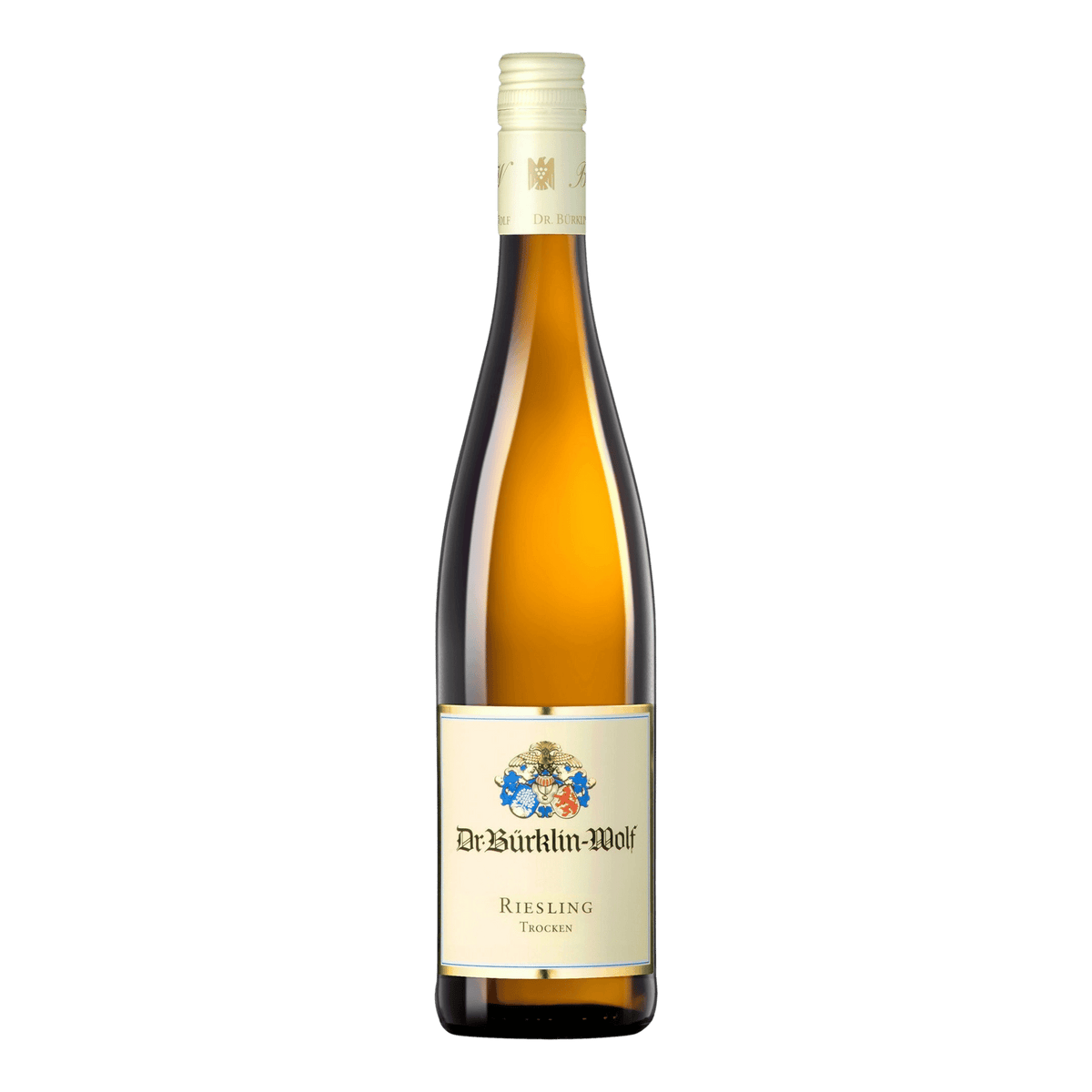
Dr. Bürklin-Wolf Riesling Trocken 2024
Dr. Bürklin-Wolf Riesling Trocken 2024
Couldn't load pickup availability
Description
Description
Dr. Bürklin-Wolf Riesling Trocken is the estate's dry entry-level Riesling, drawn from biodynamically farmed vineyards across the Mittelhaardt.
Dr. Bürklin-Wolf was founded in Wachenheim in 1597 and is one of the largest privately held estates in the Pfalz. The whole domaine has been farmed biodynamically since the early 2000s and is Demeter certified. Bettina Bürklin-von Guradze reorganised the range along Burgundian lines, with estate and village wines sitting beneath the classified Erste Lage and Grosse Lage sites. This estate bottling blends fruit from younger vines and lesser parcels across the Mittelhaardt villages of Wachenheim, Forst, Ruppertsberg and Deidesheim, on the sandstone, loam and limestone soils that run along the eastern edge of the Haardt hills. Fermentation is with ambient yeasts in stainless steel and large oak, and the wine is finished dry and sealed under screwcap.
Dry, brisk and citrus-driven; serve at 10 to 12 degrees with white fish, salads, sushi, or lighter poultry dishes.
*Every effort is made to ensure the current vintage is accurate; however, variations can occur. If you are after a specific vintage, please contact us prior to ordering.
Wine Details
Wine Details
Type: White Wine
Style: Dry (trocken)
Grape Varietal: Riesling
Tastes Like: A classic dry German Riesling from the Pfalz
Alcohol Percentage: 12%
Closure: Screwcap
Size: 750mL
Appellation: Qualitätswein Pfalz (Germany's quality wine category: grapes from one named wine region, here the Pfalz, made to that category's rules); in the estate's own four-tier ranking (Estate, Village, Premier Cru, Grand Cru) this is the Estate wine (Gutswein), the entry tier
Region: Wachenheim, Mittelhaardt, Pfalz, Germany
Terroir: Biodynamically farmed vineyards in three Mittelhaardt villages: about 60% Wachenheim, 37% Ruppertsberg and 3% Forst (Jesuitengarten); 30-50% of the blend is declassified and young-vine fruit from the estate's Premier Cru and Grand Cru sites
Aging: Fermented with natural yeasts in a mix of stainless steel and large old oak; about 6 months on lees
Serving Temperature: 8-10°C
Winery
Winery
Dr. Bürklin-Wolf in Wachenheim, in the Pfalz, traces its history to 1597, and Bernhard Bürklin, town clerk and later mayor of Wachenheim, began the family's winegrowing there. The estate took its double name in 1875, when Luise Wolf married Dr. Albert Bürklin and brought the Wolf family's vineyards in Wachenheim, Forst, Deidesheim and Ruppertsberg into the estate. Bettina Bürklin-von Guradze took over in 1990, and today the estate farms about 85 hectares in the Mittelhaardt, making it one of Germany's largest family-owned wine estates. It was among the first in Germany to rank its vineyards on the Burgundian model, from the estate wine through village wines to Premier Cru (P.C.) and Grand Cru (G.C.), with its top sites matching those rated highest in the Royal Bavarian vineyard classification of 1828. The whole estate has been farmed biodynamically since 2005, certified by Biodyvin and as organic, and the Rieslings ferment with their own natural yeasts, the single-vineyard wines in large old oak casks.
This is the estate's Riesling Trocken, the Estate wine (Gutswein) at the base of its four-tier ranking. For the 2024, about 60% of the grapes came from Wachenheim, 37% from Ruppertsberg and 3% from the Jesuitengarten in Forst, and between 30 and 50 per cent of the blend is declassified and young-vine fruit from Premier Cru and Grand Cru sites, a generous share for an entry-level wine. It fermented with its own yeasts in stainless steel and large old oak and spent about six months on its lees before bottling under screwcap. It is fully dry, with 5.9 g/L of residual sugar, at 12% alcohol. Open it as the everyday Riesling of the house: with weeknight dinners, at the start of a long lunch, or as a first look at how this estate works before stepping up to its single-vineyard wines.
Food Pairings
Food Pairings
Seafood: Pan-fried flathead fillets with lemon butter and parsley potatoes
Vegetables: White asparagus with hollandaise, new potatoes and a little ham
Light lunches: Flammkuchen (thin Alsace-style tart) with crème fraîche, onion and bacon
Pork: Pork schnitzel with a lemon wedge and a green salad
Cheese Pairings
Cheese Pairings
Butterkäse: A soft, supple German cow's milk cheese with plenty of creaminess; a dry Riesling's acidity keeps each mouthful light
Tilsiter: A semi-hard cheese with moderate salt and a springy texture, well matched to a dry wine of medium weight
Fresh goat's cheese: Soft, moist and high in acidity itself, it meets a dry Riesling on equal terms rather than overpowering it
Recipe
Recipe
Blumenkohl mit Butterbröseln (Cauliflower with Browned-Butter Breadcrumbs, Chopped Egg and Boiled Potatoes)
Ingredients (Serves 4):
- 1 large cauliflower (about 1.2 kg), outer leaves removed
- 125 mL milk (for the cooking water)
- 800 g waxy potatoes (such as Kipfler or Dutch Cream), peeled
- 4 eggs
- 100 g butter
- 1 cup (60 g) fresh breadcrumbs, or ¾ cup dried breadcrumbs
- ¼ tsp freshly grated nutmeg
- 2 tbsp finely chopped flat-leaf parsley
- Salt and white pepper
Instructions:
- Bring a large pot of well-salted water to the boil with the milk (it keeps the cauliflower white). Lower in the whole cauliflower, stem side down, and simmer for 15-20 minutes until a knife slides easily into the stem.
- At the same time, cook the potatoes in salted water for about 20 minutes until tender, then drain and keep warm.
- Boil the eggs for 9 minutes, cool them in cold water, peel and chop finely.
- Melt the butter in a frying pan over medium heat and let it foam until the milk solids turn light brown.
- Add the breadcrumbs and stir for 2-3 minutes until golden. Season with salt, white pepper and the nutmeg.
- Lift the cauliflower out carefully, drain it well and set it on a warm platter, whole or cut into large florets.
- Spoon the hot butter crumbs over the cauliflower, then scatter over the chopped egg and parsley.
- Serve straight away with the boiled potatoes.
Blumenkohl polnische Art, cauliflower "Polish style", has been a meatless standby of German home cooking for generations; the name comes from the classic à la polonaise topping of buttered crumbs and chopped egg. It is simple food built on butter and egg, so it wants a dry wine with good acidity and moderate alcohol: this Estate Riesling, with only 5.9 g/L of sugar and 12% alcohol, cuts through the browned butter and keeps a vegetarian lunch light.