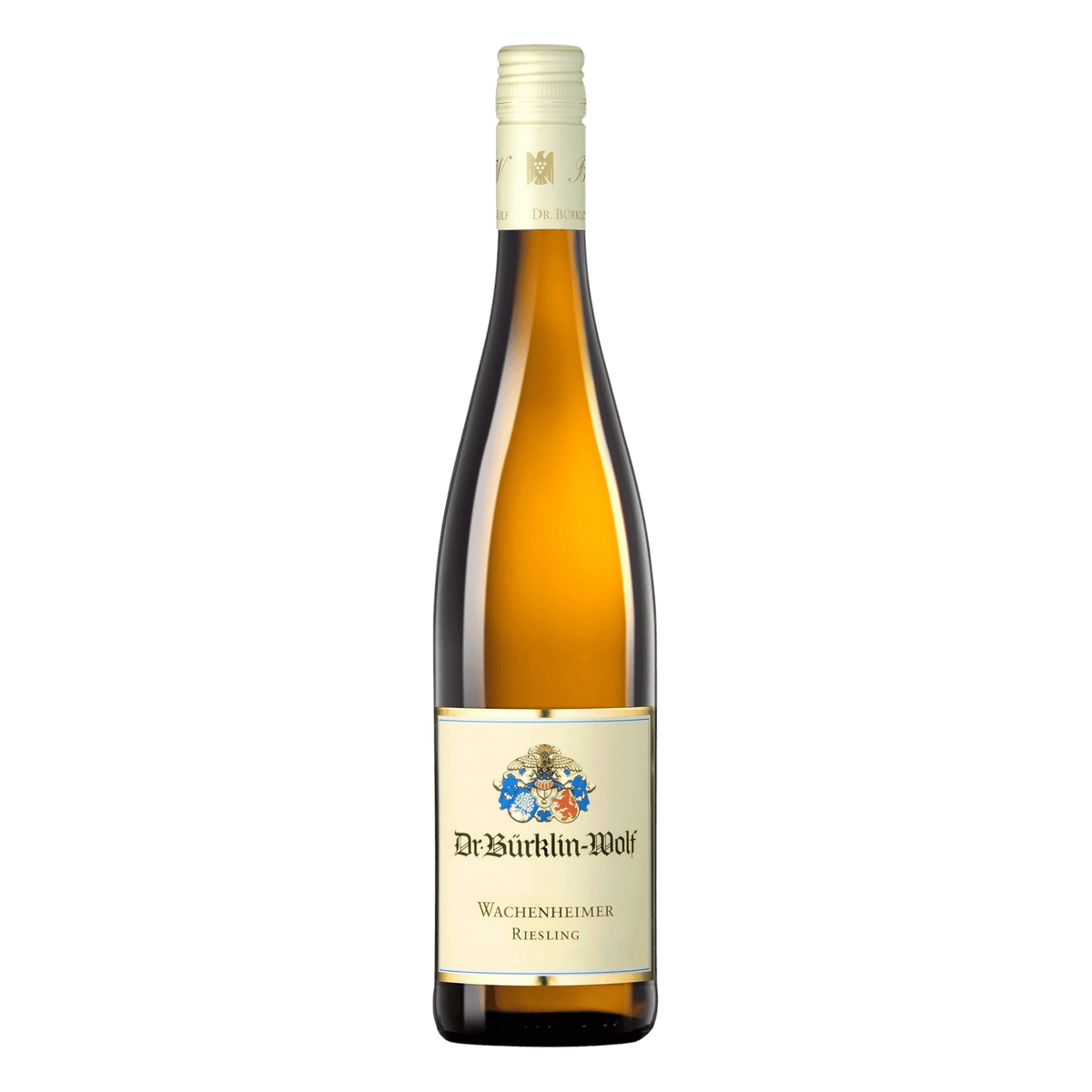
Dr. Bürklin-Wolf
Dr. Bürklin-Wolf Riesling Wachenheim 1.5L MAGNUM 2022
Dr. Bürklin-Wolf Riesling Wachenheim 1.5L MAGNUM 2022
Couldn't load pickup availability
Description
Description
Bürklin-Wolf Riesling Wachenheim is the estate's dry village wine from its home commune in the Pfalz, here in magnum.
Dr. Bürklin-Wolf was founded at Wachenheim in 1597 and is one of the larger fine-wine estates of the Mittelhaardt, farmed biodynamically under Demeter certification. Rather than follow the German Prädikat ladder, the estate ranks its wines by site in a Burgundian manner, from estate wines up through village bottlings to Premier and Grand Cru. This is the village tier for Wachenheim itself, blended from parcels around the commune where sandstone, limestone and basalt-influenced soils sit at the foot of the Haardt hills. It is fermented dry and raised in a mixture of stainless steel and large wooden casks, giving a wine with more flesh than the Mosel style but a firm dry finish.
Dry, mid-weight and food friendly, it goes with roast pork, poultry, trout and vegetable dishes; serve at around 10 to 12 degrees.
*Every effort is made to ensure the current vintage is accurate; however, variations can occur. If you are after a specific vintage, please contact us prior to ordering.
Wine Details
Wine Details
Type: White Wine
Style: Dry (trocken)
Grape Varietal: Riesling
Tastes Like: A dry German village Riesling from the Pfalz
Alcohol Percentage: 12%
Closure: Screwcap
Size: 1.5L (magnum)
Appellation: Qualitätswein Pfalz (Germany's quality wine category: grapes from one named wine region, here the Pfalz, made to that category's rules); in the estate's own four-tier ranking (Estate, Village, Premier Cru, Grand Cru) this is a Village wine, made from vineyards around one village, here Wachenheim
Region: Wachenheim, Mittelhaardt, Pfalz, Germany
Terroir: Declassified and younger-vine fruit from the estate's Wachenheim vineyards
Aging: Fermented with natural yeasts in stainless steel and a large oak cask (Doppelstück)
Serving Temperature: 8-10°C
Winery
Winery
Dr. Bürklin-Wolf in Wachenheim, in the Pfalz, traces its history to 1597, and Bernhard Bürklin, town clerk and later mayor of Wachenheim, began the family's winegrowing there. The estate took its double name in 1875, when Luise Wolf married Dr. Albert Bürklin and brought the Wolf family's vineyards in Wachenheim, Forst, Deidesheim and Ruppertsberg into the estate. Bettina Bürklin-von Guradze took over in 1990, and today the estate farms about 85 hectares in the Mittelhaardt, making it one of Germany's largest family-owned wine estates. It was among the first in Germany to rank its vineyards on the Burgundian model, from the estate wine through village wines to Premier Cru (P.C.) and Grand Cru (G.C.), with its top sites matching those rated highest in the Royal Bavarian vineyard classification of 1828. The whole estate has been farmed biodynamically since 2005, certified by Biodyvin and as organic, and the Rieslings ferment with their own natural yeasts, the single-vineyard wines in large old oak casks.
Wachenheim is the estate's home village, and this Village Riesling gathers declassified and younger-vine grapes from the estate's Wachenheim vineyards, which include its five Premier Cru sites. It ferments with its own yeasts in steel tanks and a large oak cask and is bottled dry under screwcap. The 2022 vintage was the driest on record in the Pfalz, with small yields and a quick harvest that began in early September. In magnum, this is a dry Riesling for a table of friends: about twelve glasses in one bottle, and the large format keeps it fresh for longer.
Food Pairings
Food Pairings
Pasta and noodles: Rolled noodle dough with sauerkraut and bacon, pan-crisped
Pork: Roast pork belly with apple and caraway
Seafood: Fish and chips with a herb mayonnaise
Vegetarian: Cheese and spinach dumplings with brown butter
Cheese Pairings
Cheese Pairings
Allgäuer Bergkäse (aged): An aged Allgäu mountain cheese, nutty and firm, from the same region as the recipe
Limburger: A soft washed-rind cheese with a strong rind; a dry Riesling's acidity resets the palate
Raclette: The Swiss and French melting cheese, good with dry white wine
Recipe
Recipe
Allgäuer Krautkrapfen (Allgäu Sauerkraut and Bacon Noodle Rolls)
Ingredients (Serves 4):
- For the dough: 300 g plain flour, 2 eggs, 80 mL water, 1 tbsp oil and a pinch of salt
- 500 g sauerkraut, drained and squeezed
- 150 g speck or smoked bacon, finely diced
- 1 onion, finely chopped
- 2 tbsp butter or lard, plus 2 tbsp for the pan
- 1 tsp caraway seeds
- 300 mL hot beef or vegetable stock
- Salt and black pepper
- Sour cream and chopped chives, to serve
Instructions:
- Knead the flour, eggs, water, oil and salt into a smooth, firm dough. Cover and rest for 30 minutes.
- Fry the bacon and onion in the butter until golden, add the sauerkraut and caraway and cook for 10 minutes. Season and leave to cool.
- Roll the dough out on a floured cloth into a thin rectangle, about 40 x 50 cm.
- Spread the sauerkraut filling evenly over the dough, leaving a border, and roll it up tightly from the long side. Cut into slices about 5 cm thick.
- Melt the remaining butter in a large frying pan with a lid. Stand the slices in the pan, cut side down, and fry for 5 minutes until the bottoms are golden.
- Pour the hot stock around them, cover and cook over low heat for 20-25 minutes until the stock is absorbed and the bases are crisp again. Serve with sour cream and chives.
Krautkrapfen are a farmhouse dish of the Allgäu, in the far south of Germany: a thin noodle dough rolled up with sauerkraut and bacon, then cooked in the pan until the tops are tender and the bases crisp. The sour cabbage, smoky bacon and buttery crust want a dry, fresh white, and a magnum of Wachenheim village Riesling cuts the richness while matching the sauerkraut's tang, at a moderate 12% alcohol.