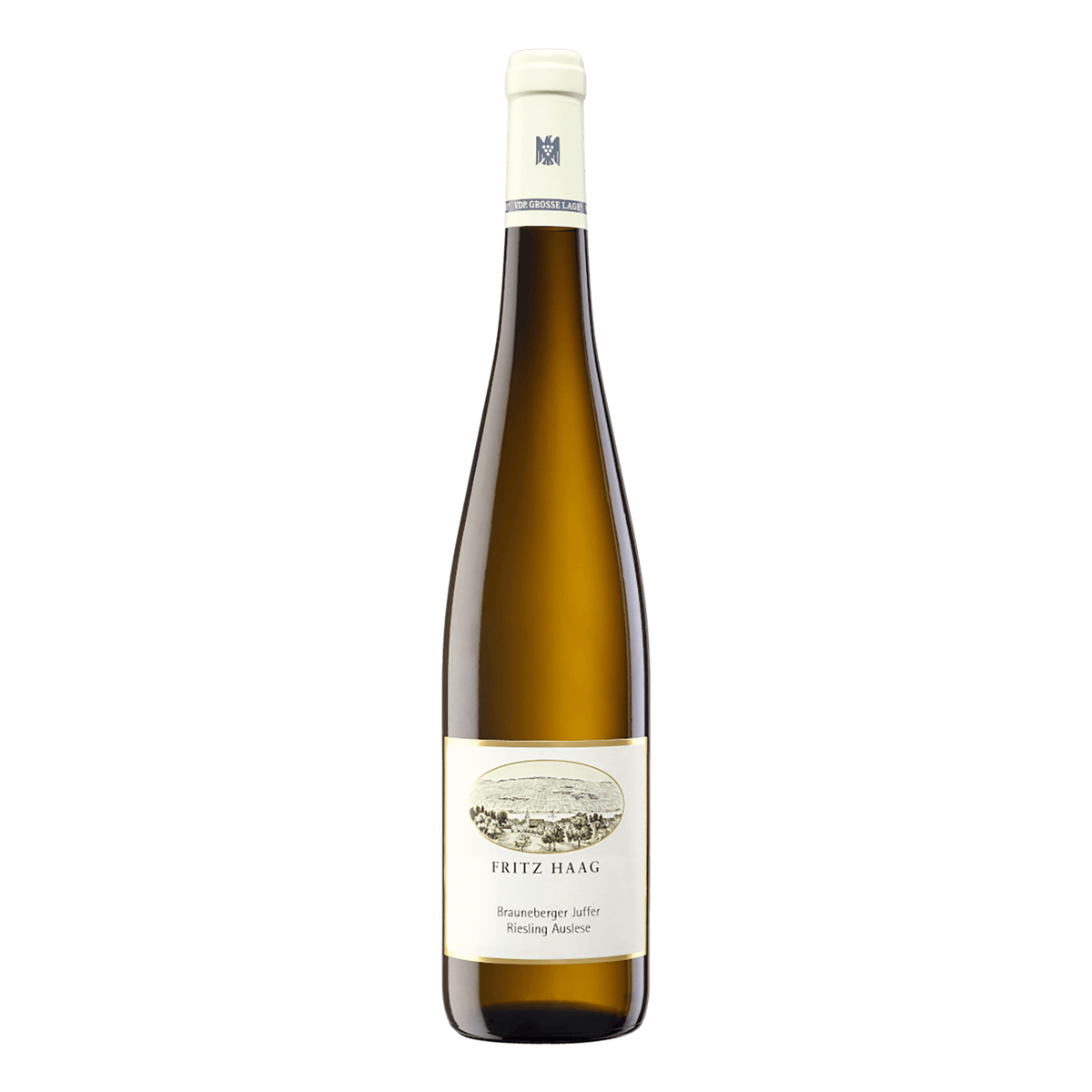
Fritz Haag
Fritz Haag Brauneberger Juffer Riesling Auslese 2023
Fritz Haag Brauneberger Juffer Riesling Auslese 2023
Couldn't load pickup availability
Description
Description
Fritz Haag Brauneberger Juffer Riesling Auslese is a richer, later-picked expression of the Brauneberg's great slate slope.
Auslese at Fritz Haag is made from individually selected bunches harvested well after the main picking, usually carrying a proportion of botrytis-affected berries alongside fully ripe, shrivelled fruit. The source is the Brauneberger Juffer, a steep south-facing amphitheatre of weathered blue Devonian slate on the left bank of the Middle Mosel, farmed by the Haag family for over four centuries and directed today by Oliver Haag. The must ferments gently in stainless steel and traditional Fuder casks and is arrested with close to 97 grams per litre of residual sugar. Alcohol stays low in the traditional Mosel manner, so the wine depends on acidity and extract rather than weight for its structure.
Concentrated and honeyed yet lifted, and built to keep for decades; serve at 8 to 10 degrees with blue cheese, tarte tatin, or on its own after a meal.
*Every effort is made to ensure the current vintage is accurate; however, variations can occur. If you are after a specific vintage, please contact us prior to ordering.
Wine Details
Wine Details
Type: White Wine (dessert)
Style: Sweet (Auslese, 97 g/L residual sugar, 7.8 g/L acidity)
Grape Varietal: Riesling
Tastes Like: A classic sweet Mosel Riesling Auslese
Alcohol Percentage: 7.5%
Closure: Natural cork
Size: 750mL
Appellation: Prädikatswein Mosel (Germany's top quality category, graded by the ripeness of the grapes at harvest; Auslese means "selected harvest": selected bunches picked riper than for Spätlese). The Brauneberger Juffer is classified VDP.Grosse Lage, the top tier of the VDP growers' association's own vineyard ranking, comparable to a grand cru
Region: Brauneberg, Middle Mosel, Germany
Terroir: The Brauneberger Juffer, a south-facing slope of fine weathered Devonian slate running for almost two kilometres along the left bank of the Mosel, opposite the village; the estate gives gradients of up to 80 per cent
Aging: Gentle hand harvest with strict selection of fully ripened grapes; fermented with natural yeasts and aged on fine lees, as is the estate's practice; released from 1 May of the year after harvest, as the VDP requires for fruity Prädikat wines from Grosse Lage sites
Serving Temperature: 8-10°C
Winery
Winery
Weingut Fritz Haag is a family estate in Brauneberg on the Middle Mosel, first documented in 1605, when the village was still called Dusemond. The village renamed itself Brauneberg in 1925 to draw on the fame of its great vineyard, the Juffer, which faces the village from the opposite bank of the river: a south-facing slope of weathered Devonian slate that runs for almost two kilometres along the left bank, with the Juffer Sonnenuhr, named after the sundial that stands among its vines, at its heart. Brauneberg's reputation is old: Thomas Jefferson rated its wine first quality in 1788, and Napoleon's 1804 tax survey of the Moselle vineyards confirmed its top standing. Wilhelm Haag, who came home to run the estate in 1957, led the Grosser Ring (today VDP.Mosel) for many years, and his younger son Oliver took over in 2005 and runs the estate with his wife Jessica. Every vine is Riesling, all five of the estate's sites are classified VDP.Grosse Lage, the association's top tier, the grapes are picked by hand on slopes as steep as 80 per cent, and the wines ferment with their own natural yeasts.
The Juffer Auslese is made from the Brauneberger Juffer, the long slate slope across the river from the estate. Auslese means "selected harvest": the estate picks by hand with a strict selection of fully ripened grapes, riper than those used for Spätlese, and describes the result as fleet-footed, balanced and precise. The 2023 has 97 g/L of residual sugar and 7.8 g/L of acidity at only 7.5% alcohol, so it carries real sweetness without heaviness. It is a wine to open at the end of a dinner party, with a layered cake or a cheese board, when a glass of something sweet and light is exactly what the table needs.
Food Pairings
Food Pairings
Desserts: Apricot and almond tart, or apple strudel with vanilla sauce
Fruit: Poached pears in vanilla syrup with mascarpone
Savoury: Chicken liver parfait with brioche toast and quince paste
Cheese board: Blue cheeses with walnuts, dried figs and oatcakes
Cheese Pairings
Cheese Pairings
Bavaria Blu: A rich, creamy Bavarian blue with a soft white rind; its salt and creaminess are made for the sweetness of an Auslese
Roquefort: The classic French sheep's milk blue; its strong salt is softened by the wine's 97 g/L of sugar and its fat is cut by the acidity
Mimolette (aged 18 months): A hard French cheese with a crumbly texture; its density and salt balance the wine's sweetness without competing
Recipe
Recipe
Prinzregententorte (Bavarian Seven-Layer Prince Regent Torte with Chocolate Buttercream)
Ingredients (Makes one 24 cm torte, 14-16 slices):
- 250 g unsalted butter, softened (for the sponge)
- 220 g caster sugar
- 1 tsp vanilla extract and a pinch of salt
- 5 eggs, at room temperature
- 250 g plain flour
- 1 tsp baking powder
- 500 mL full-cream milk (for the buttercream)
- 40 g cornflour and 20 g Dutch-process cocoa
- 100 g caster sugar (for the buttercream)
- 150 g dark chocolate (about 55% cocoa), chopped
- 250 g unsalted butter, softened (for the buttercream)
- 3 tbsp apricot jam, warmed and sieved
- 200 g dark chocolate and 1 tbsp vegetable oil (for the glaze)
Instructions:
- For the buttercream base, whisk the cornflour, cocoa, sugar and 125 mL of the milk until smooth. Bring the rest of the milk to the boil, whisk in the cornflour mixture and cook, stirring, for 1-2 minutes until thick. Stir in the 150 g chocolate until melted, press baking paper onto the surface and cool to room temperature (not fridge-cold).
- Heat the oven to 200°C (180°C fan). Draw a 24 cm circle on 7 sheets of baking paper and turn them over.
- Beat the butter, sugar, vanilla and salt until pale and fluffy. Add the eggs one at a time, beating well, then fold in the flour sifted with the baking powder.
- Spread about 3 heaped tbsp of batter thinly and evenly inside each circle. Bake two sheets at a time on trays for 6-8 minutes, until pale golden at the edges. Slide off the trays and cool on the paper.
- Beat the 250 g softened butter until very pale and creamy, about 5 minutes. Add the cooled chocolate custard a spoonful at a time, beating constantly, until smooth. Both must be at the same room temperature or the buttercream will split.
- Peel the paper from the first sponge, place it on a cake board and spread with a thin layer of buttercream. Repeat with the remaining layers, finishing with a sponge on top. Spread the remaining buttercream thinly around the sides. Chill for 1 hour.
- Brush the top with the warm apricot jam and chill for 15 minutes.
- Melt the 200 g chocolate with the oil over a pan of barely simmering water. Pour over the top of the torte and spread quickly so it runs down the sides. Chill until set, then bring to room temperature for 30 minutes before slicing with a hot knife.
The Prinzregententorte was created in Munich in honour of Luitpold, Prince Regent of Bavaria from 1886, and its seven thin layers are said to stand for the seven administrative regions of the Bavarian kingdom of the time. A slice is rich with butter and chocolate, so it needs a wine with both sweetness and acidity: the Juffer Auslese is at least as sweet as the cake, so the cake does not make it seem thin, while its acidity cuts through the buttercream and its low 7.5% alcohol keeps the pairing light at the end of a meal.