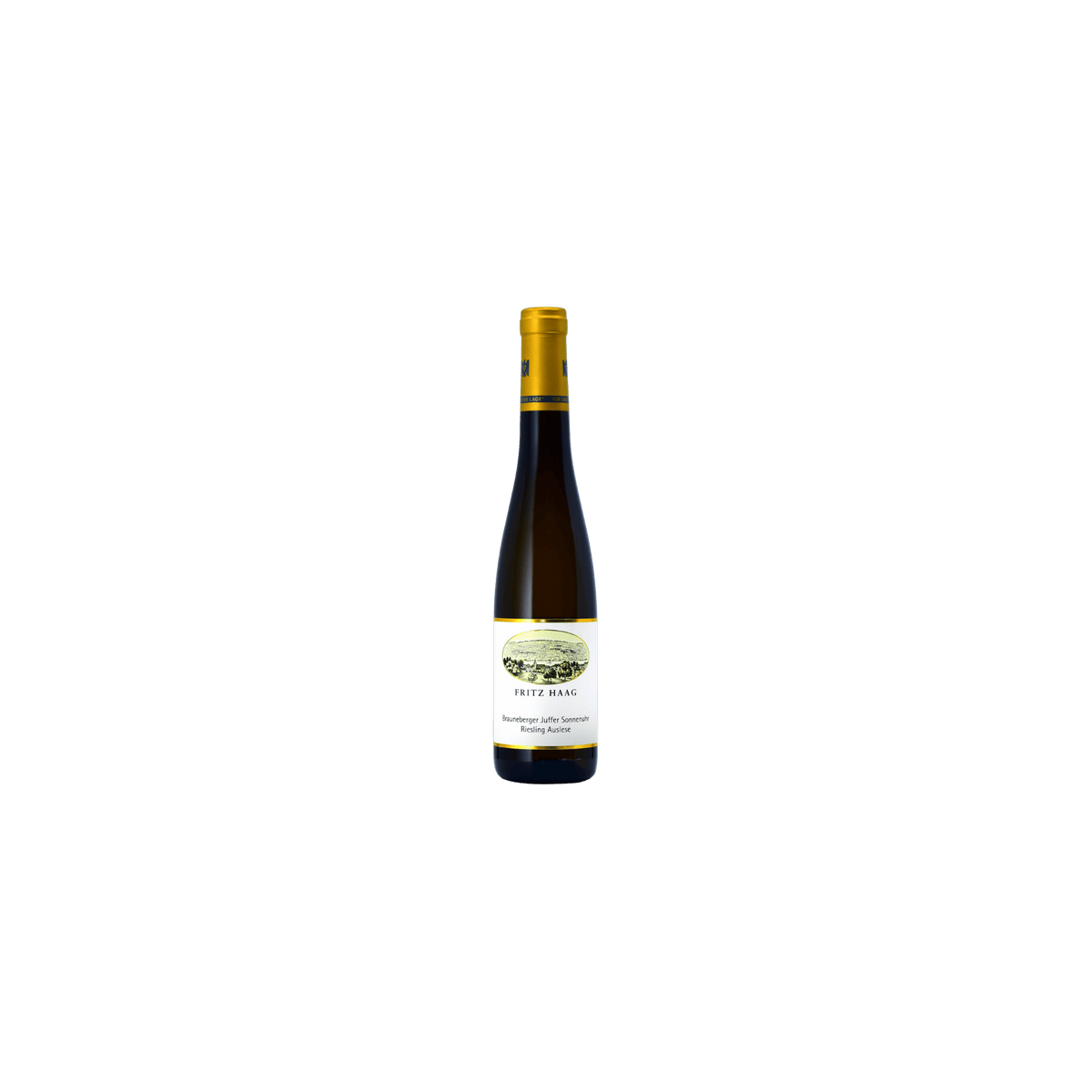
Fritz Haag
Fritz Haag Brauneberger Juffer-Sonnenuhr Riesling Auslese Gold Cap 375ml 2022
Fritz Haag Brauneberger Juffer-Sonnenuhr Riesling Auslese Gold Cap 375ml 2022
Couldn't load pickup availability
Description
Description
Fritz Haag Brauneberger Juffer-Sonnenuhr Riesling Auslese Gold Cap is the estate's stricter Auslese selection, drawn from the most heavily botrytised fruit on the slope.
The Juffer-Sonnenuhr is the core of the Brauneberger Juffer, a south facing wall of blue Devonian slate on the left bank of the Mosel, named for the sundial built into it and long counted among the finest sites on the river. The Haag family has farmed here since 1605 and the estate is run today by Oliver Haag, who picks in successive passes so that the Auslese is assembled from individually selected bunches touched by noble rot. Fermentation is spontaneous and slow in traditional Fuder cask, and stops of its own accord. The gold capsule is a long standing German convention marking a selection well above the legal Auslese minimum, and this bottling is the richer of the two in the range, finishing at around 142 grams per litre of residual sugar with the slate acidity keeping it taut.
Unctuous but never heavy, it suits blue cheese, foie gras and rich fruit desserts, or a glass on its own; serve well chilled at 8 to 10 degrees.
*Every effort is made to ensure the current vintage is accurate; however, variations can occur. If you are after a specific vintage, please contact us prior to ordering.
Wine Details
Wine Details
Type: White Wine (dessert)
Style: Sweet (Auslese Goldkapsel, about 125 g/L residual sugar per Vinous)
Grape Varietal: Riesling
Tastes Like: A rich, sweet Mosel Riesling Auslese in the gold-capsule style, made with botrytis
Alcohol Percentage: 7.5%
Closure: Natural cork
Size: 375mL (half bottle)
Appellation: Deutscher Prädikatswein Mosel (Germany's top quality category, graded by the ripeness of the grapes at harvest; Auslese means "selected harvest": selected bunches picked riper than for Spätlese). Goldkapsel (gold capsule) is not a legal category: it is an unofficial marker that some estates use for a richer selection of their Auslese. The Juffer Sonnenuhr is classified VDP.Grosse Lage, the top tier of the VDP growers' association's own vineyard ranking, comparable to a grand cru
Region: Brauneberg, Middle Mosel, Germany
Terroir: The Juffer Sonnenuhr, the heart of the Brauneberger Juffer, named after the sundial that stands among its vines; a steep slope facing south to south-west at 110-210 m above sea level, on extremely poor Devonian slate, across the river from the village
Aging: Made from 30-40 per cent botrytis-affected grapes (noble rot, which shrivels the grapes and concentrates their sugar and acidity) and matured in stainless steel; released from 1 May of the year after harvest, as the VDP requires for fruity Prädikat wines from Grosse Lage sites
Serving Temperature: 8-10°C
Winery
Winery
Weingut Fritz Haag is a family estate in Brauneberg on the Middle Mosel, first documented in 1605, when the village was still called Dusemond. The village renamed itself Brauneberg in 1925 to draw on the fame of its great vineyard, the Juffer, which faces the village from the opposite bank of the river: a south-facing slope of weathered Devonian slate that runs for almost two kilometres along the left bank, with the Juffer Sonnenuhr, named after the sundial that stands among its vines, at its heart. Brauneberg's reputation is old: Thomas Jefferson rated its wine first quality in 1788, and Napoleon's 1804 tax survey of the Moselle vineyards confirmed its top standing. Wilhelm Haag, who came home to run the estate in 1957, led the Grosser Ring (today VDP.Mosel) for many years, and his younger son Oliver took over in 2005 and runs the estate with his wife Jessica. Every vine is Riesling, all five of the estate's sites are classified VDP.Grosse Lage, the association's top tier, the grapes are picked by hand on slopes as steep as 80 per cent, and the wines ferment with their own natural yeasts.
A gold capsule is an unofficial marker, not a legal category, that some German estates use for a richer selection of their Auslese, and at Haag the Juffer Sonnenuhr Auslese Goldkapsel is made with some botrytis. In 2022 that meant 30 to 40 per cent of the grapes were affected by noble rot, which shrivels ripe berries and concentrates their sugar and acidity, and the wine was matured in stainless steel. The year itself brought a warm spring with no late frost and a dry summer of drought that the old vines handled better than the young ones, then autumn rain that made the timing of picking and careful selection crucial. Vinous puts the residual sugar at about 125 g/L, at 7.5% alcohol. Open the half bottle with a rich dessert or a cheese board for four.
Food Pairings
Food Pairings
Desserts: Pear and walnut frangipane tart, or caramelised apple crêpes
Baking: Bienenstich (German bee-sting cake with honey-almond topping and custard cream)
Fruit: Grilled figs wrapped in prosciutto with a drizzle of honey
Savoury: Pork rillettes with toasted sourdough and cornichons, or a terrine of duck
Cheese Pairings
Cheese Pairings
Montagnolo Affiné: A Bavarian triple-cream blue with a grey rind, rich and gently salty; the wine's sweetness and acidity match its buttery depth
Bleu d'Auvergne: A sharper, saltier French blue; a very sweet wine like this softens its bite and the acidity cleans the palate
Époisses: A strong, creamy washed-rind cheese from Burgundy; its salt and strength need a wine with this much sugar and acidity to balance them
Recipe
Recipe
Nussecken (German Nut Triangles with Apricot Jam and Chocolate-Dipped Corners)
Ingredients (Makes about 32 triangles):
- 300 g plain flour
- 1 tsp baking powder
- 130 g caster sugar (for the base)
- 1 egg
- 130 g cold unsalted butter, diced (for the base)
- 150 g apricot jam
- 200 g unsalted butter (for the topping)
- 200 g caster sugar (for the topping)
- 1 tsp vanilla extract
- 4 tbsp water
- 200 g hazelnut meal
- 200 g hazelnuts, roughly chopped
- 200 g dark chocolate, chopped
Instructions:
- Mix the flour, baking powder and 130 g sugar, add the egg and cold butter and knead quickly into a smooth shortcrust dough. Wrap and chill for 30 minutes.
- Heat the oven to 175°C (155°C fan) and line a 25 x 38 cm slice tray with baking paper.
- Roll or press the dough evenly over the base of the tray and prick with a fork. Spread the apricot jam thinly over the top.
- For the topping, melt the 200 g butter with the 200 g sugar, vanilla and water in a saucepan over low heat, stirring until the sugar dissolves. Take off the heat and stir in the hazelnut meal and chopped hazelnuts.
- Spread the nut mixture evenly over the jam with the back of a wet spoon.
- Bake for 25-30 minutes, until the topping is golden. Cool completely in the tray.
- Lift out and cut into 8 cm squares, then cut each square diagonally into two triangles.
- Melt the chocolate over a pan of barely simmering water. Dip the two acute corners of each triangle into the chocolate and set on baking paper until firm. Store in an airtight tin for up to a week.
Nussecken are a fixture of German home baking and bakery counters, found all over the country with afternoon coffee and on festive season biscuit plates. Buttery shortcrust, a layer of jam, a dense hazelnut topping and chocolate make a rich, sweet bite, so the wine beside it needs plenty of sugar of its own and the acidity to cut the butter and nuts. The 2022 Gold Cap has both, with about 125 g/L of sugar to stand level with the biscuit and enough acidity to keep each mouthful fresh, while its light 7.5% alcohol suits an afternoon or after-dinner glass.