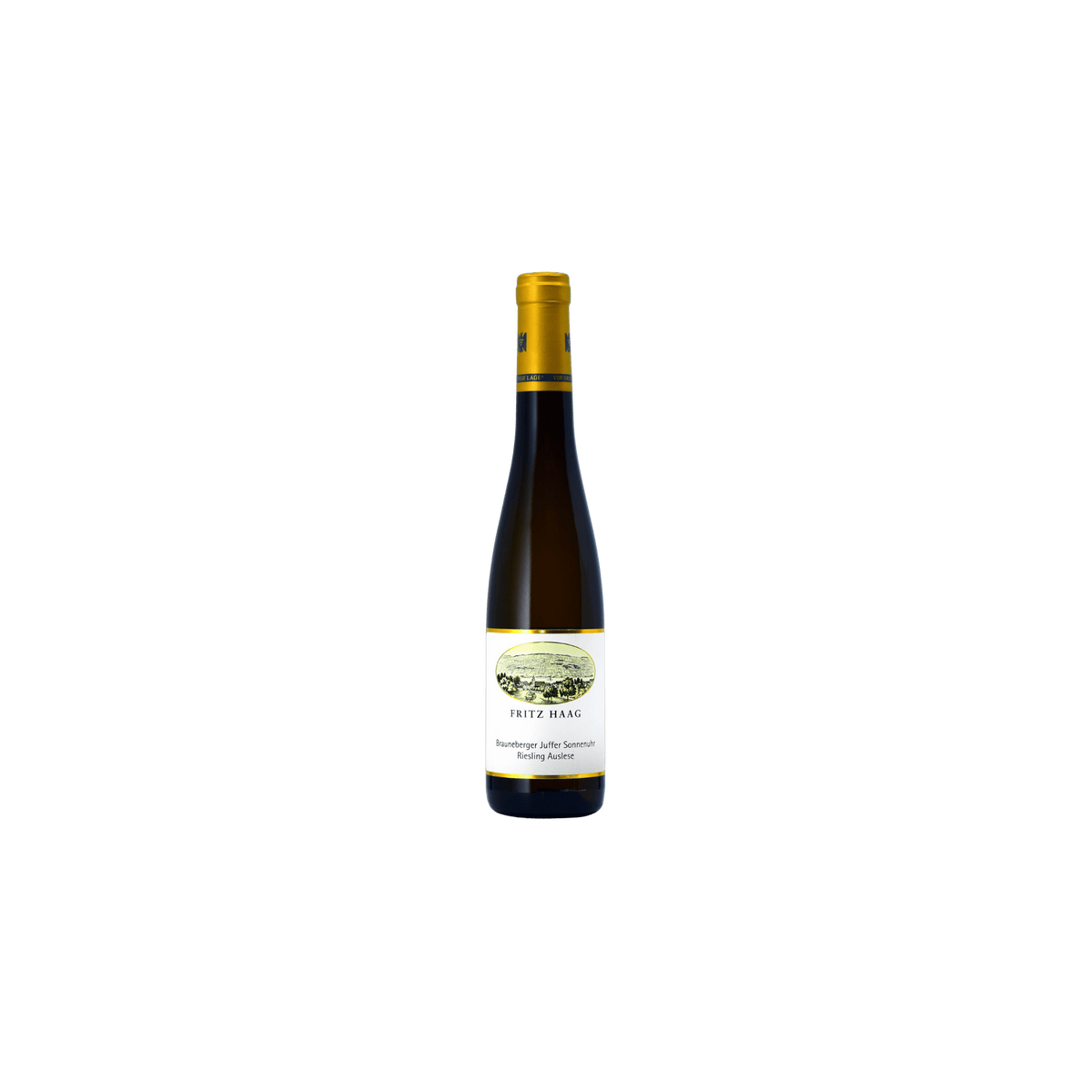
Fritz Haag
Fritz Haag Brauneberger Juffer Sonnenuhr Riesling Auslese Gold Cap 375ml 2023
Fritz Haag Brauneberger Juffer Sonnenuhr Riesling Auslese Gold Cap 375ml 2023
Couldn't load pickup availability
Description
Description
Fritz Haag Brauneberger Juffer Sonnenuhr Riesling Auslese Gold Cap is the estate's most selective Auslese, marked out by its gold capsule.
German estates traditionally use capsule colour to distinguish successive levels of Auslese, and the gold capsule denotes the most rigorous selection of the harvest: the ripest, most heavily botrytis-affected berries, picked out individually from the Juffer Sonnenuhr. That parcel, around the sundial at the steepest point of the Brauneberg, sits on thin weathered blue Devonian slate with a direct southern aspect. Fritz Haag presses gently, ferments slowly in stainless steel and traditional Fuder, and stops the fermentation with about 141 grams per litre of residual sugar, well into dessert wine territory. Alcohol remains very low, and the wine is released in half bottles.
Unctuous but held together by Mosel acidity, and a wine for very long ageing; serve at 8 to 10 degrees in small glasses with blue cheese or on its own.
*Every effort is made to ensure the current vintage is accurate; however, variations can occur. If you are after a specific vintage, please contact us prior to ordering.
Wine Details
Wine Details
Type: White Wine (dessert)
Style: Sweet (Auslese Goldkapsel, 141 g/L residual sugar, 11.6 g/L acidity)
Grape Varietal: Riesling
Tastes Like: A rich, sweet Mosel Riesling Auslese in the gold-capsule style, made with some botrytis
Alcohol Percentage: 7.5%
Closure: Natural cork
Size: 375mL (half bottle)
Appellation: Prädikatswein Mosel (Germany's top quality category, graded by the ripeness of the grapes at harvest; Auslese means "selected harvest": selected bunches picked riper than for Spätlese). Goldkapsel (gold capsule) is not a legal category: it is an unofficial marker that some estates use for a richer selection of their Auslese. The Juffer Sonnenuhr is classified VDP.Grosse Lage, the top tier of the VDP growers' association's own vineyard ranking, comparable to a grand cru
Region: Brauneberg, Middle Mosel, Germany
Terroir: The Juffer Sonnenuhr, the heart of the Brauneberger Juffer, named after the sundial that stands among its vines; a steep slope facing south to south-west at 110-210 m above sea level, on extremely poor Devonian slate, across the river from the village
Aging: Made with some botrytis (noble rot, which shrivels the grapes and concentrates their sugar and acidity); fermented with natural yeasts and aged on fine lees, as is the estate's practice; released from 1 May of the year after harvest, as the VDP requires for fruity Prädikat wines from Grosse Lage sites
Serving Temperature: 8-10°C
Winery
Winery
Weingut Fritz Haag is a family estate in Brauneberg on the Middle Mosel, first documented in 1605, when the village was still called Dusemond. The village renamed itself Brauneberg in 1925 to draw on the fame of its great vineyard, the Juffer, which faces the village from the opposite bank of the river: a south-facing slope of weathered Devonian slate that runs for almost two kilometres along the left bank, with the Juffer Sonnenuhr, named after the sundial that stands among its vines, at its heart. Brauneberg's reputation is old: Thomas Jefferson rated its wine first quality in 1788, and Napoleon's 1804 tax survey of the Moselle vineyards confirmed its top standing. Wilhelm Haag, who came home to run the estate in 1957, led the Grosser Ring (today VDP.Mosel) for many years, and his younger son Oliver took over in 2005 and runs the estate with his wife Jessica. Every vine is Riesling, all five of the estate's sites are classified VDP.Grosse Lage, the association's top tier, the grapes are picked by hand on slopes as steep as 80 per cent, and the wines ferment with their own natural yeasts.
A gold capsule is not an official German wine category but an unofficial marker that some estates put on the foil of a richer selection, usually an Auslese, and the words do not appear on the label. At Haag, the Juffer Sonnenuhr Auslese Goldkapsel is made with some botrytis, the noble rot that shrivels ripe grapes and concentrates them. The difference shows in the numbers: the 2023 Gold Cap has 141 g/L of residual sugar against 98 g/L for the estate's standard 2023 Sonnenuhr Auslese, with a high 11.6 g/L of acidity to carry it and only 7.5% alcohol. It is a wine for a small glass at the end of a special dinner, with a rich dessert or a plate of blue cheese, and the half bottle serves four people comfortably.
Food Pairings
Food Pairings
Desserts: Tarte Tatin with crème fraîche, or sticky date pudding with butterscotch sauce
Pastries: Almond croissants or Portuguese custard tarts with afternoon coffee
Fruit: Baked quinces with honey and mascarpone
Savoury: Seared foie gras or duck liver on toasted brioche with caramelised apple
Cheese Pairings
Cheese Pairings
Bergader Edelpilz: A Bavarian blue from the Chiemgau, salty and creamy; the wine's 141 g/L of sugar and high acidity are a perfect counterweight to its salt
Fourme d'Ambert: A mild, creamy French blue from the Auvergne; its gentle salt lets the wine's richness and acidity take the lead
Aged Gouda (3 years): A hard, crystalline Dutch cheese with a dense, firm texture; its salt and dense texture stand up to a very sweet wine
Recipe
Recipe
Leipziger Lerchen (Leipzig Almond-Marzipan Tartlets with a Hidden Cherry)
Ingredients (Makes 12 tartlets):
- 250 g plain flour (for the pastry)
- 125 g cold unsalted butter, diced
- 80 g icing sugar and a pinch of salt
- 1 egg
- 150 g marzipan (or raw almond paste), grated
- 75 g unsalted butter, softened (for the filling)
- 50 g caster sugar
- 2 eggs (for the filling)
- 75 g almond meal
- 30 g plain flour (for the filling)
- 1 tbsp rum or kirsch (optional)
- 12 sour (morello) cherries from a jar, well drained
- 2 tbsp apricot jam
- Icing sugar, for dusting
Instructions:
- Rub the flour, icing sugar, salt and cold butter together until the mixture looks like breadcrumbs. Add the egg and bring together quickly into a dough. Wrap and chill for 30 minutes.
- For the filling, beat the marzipan, softened butter and caster sugar until smooth. Beat in the eggs one at a time, then fold in the almond meal, flour and rum, if using.
- Heat the oven to 180°C (160°C fan) and grease a 12-hole muffin tin.
- Roll out two thirds of the pastry to 3 mm thick, cut out 12 rounds of about 10 cm and press them into the tin. Put 1/2 tsp of apricot jam in the base of each.
- Place a cherry in each pastry case and cover with the almond filling, about three quarters full.
- Roll out the remaining pastry, cut into thin strips and lay two strips in a cross over each tartlet, pressing the ends onto the pastry edge.
- Bake for 25-30 minutes, until the pastry is golden and the filling is set. Cool in the tin for 10 minutes, then lift out onto a rack.
- Dust generously with icing sugar before serving.
Leipziger Lerchen take their name from the larks that were once caught and baked in pies around Leipzig. When the King of Saxony banned lark hunting in 1876, the city's bakers created a sweet pastry in their place, with the pastry cross said to be the string that tied the bird and the hidden cherry its heart, and they remain a Leipzig speciality today. Buttery pastry and a rich almond filling call for a wine with both real sweetness and high acidity, and the Gold Cap has both: its 141 g/L of sugar stands up to the marzipan, while its 11.6 g/L of acidity cuts the butter and refreshes the palate between bites.