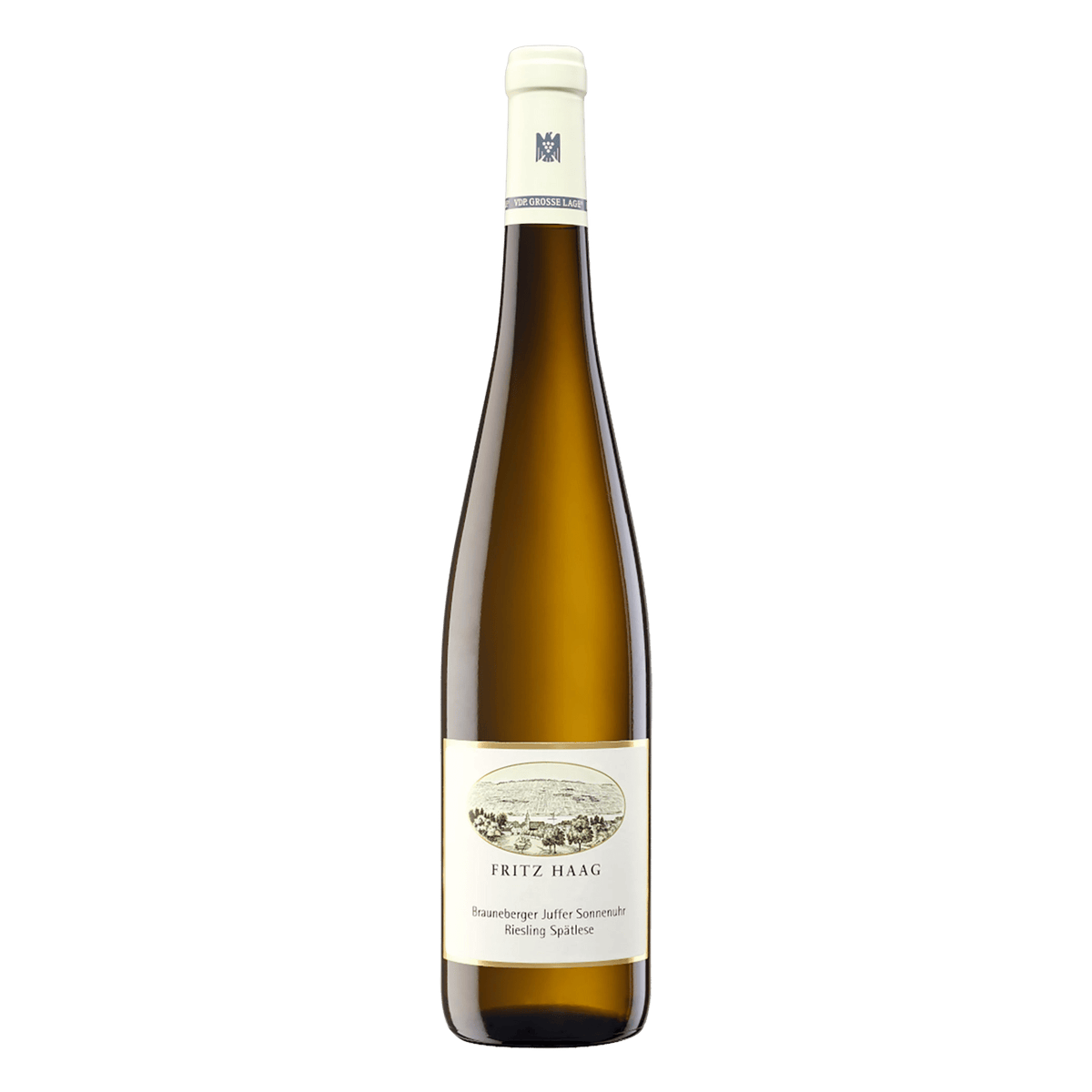
Fritz Haag
Fritz Haag Brauneberger Juffer Sonnenuhr Riesling Spätlese 1.5L MAGNUM 2023
Fritz Haag Brauneberger Juffer Sonnenuhr Riesling Spätlese 1.5L MAGNUM 2023
Couldn't load pickup availability
Description
Description
Fritz Haag Brauneberger Juffer Sonnenuhr Riesling Spätlese comes from the finest heart of the Brauneberg slope, here in magnum.
The Juffer Sonnenuhr is the central, steepest portion of the Brauneberg, named for the sundial set among the vines, and it is generally held to be the best exposition on the hill: pure blue Devonian slate, angled south towards the river, with the water reflecting light and moderating temperature. Fritz Haag, in family hands since 1605 and led today by Oliver Haag, farms parcels of old vines here. Spätlese means a later picking at higher must weight than Kabinett, and in the classic Mosel style the fermentation is stopped with substantial residual sugar remaining, held in balance by the site's high natural acidity and bottled at low alcohol.
Sweet but weightless, with acidity that keeps it clean, it suits blue cheese, fruit tarts and spiced dishes, or a glass on its own; serve chilled at around 8 degrees.
*Every effort is made to ensure the current vintage is accurate; however, variations can occur. If you are after a specific vintage, please contact us prior to ordering.
Wine Details
Wine Details
Type: White Wine
Style: Sweet (fruity-sweet Spätlese, 81 g/L residual sugar)
Grape Varietal: Riesling
Tastes Like: A classic sweet Mosel Riesling Spätlese from a top single vineyard
Alcohol Percentage: 7.5%
Size: 1.5L (magnum)
Appellation: Prädikatswein Mosel (Germany's top quality category, graded by the ripeness of the grapes at harvest; Spätlese means "late harvest": grapes picked riper than for Kabinett). The Juffer Sonnenuhr is classified VDP.Grosse Lage, the top tier of the VDP growers' association's own vineyard ranking, comparable to a grand cru
Region: Brauneberg, Middle Mosel, Germany
Terroir: The Juffer Sonnenuhr, the heart of the Brauneberger Juffer, named after the sundial that stands among its vines; a steep slope facing south to south-west at 110-210 m above sea level, on extremely poor Devonian slate, across the river from the village
Aging: Gently pressed, fermented with its own natural yeasts and rested on fine lees over winter; released from 1 May of the year after harvest, as the VDP requires for fruity Prädikat wines from Grosse Lage sites
Serving Temperature: 8-10°C
Winery
Winery
Weingut Fritz Haag is a family estate in Brauneberg on the Middle Mosel, first documented in 1605, when the village was still called Dusemond. The village renamed itself Brauneberg in 1925 to draw on the fame of its great vineyard, the Juffer, which faces the village from the opposite bank of the river: a south-facing slope of weathered Devonian slate that runs for almost two kilometres along the left bank, with the Juffer Sonnenuhr, named after the sundial that stands among its vines, at its heart. Brauneberg's reputation is old: Thomas Jefferson rated its wine first quality in 1788, and Napoleon's 1804 tax survey of the Moselle vineyards confirmed its top standing. Wilhelm Haag, who came home to run the estate in 1957, led the Grosser Ring (today VDP.Mosel) for many years, and his younger son Oliver took over in 2005 and runs the estate with his wife Jessica. Every vine is Riesling, all five of the estate's sites are classified VDP.Grosse Lage, the association's top tier, the grapes are picked by hand on slopes as steep as 80 per cent, and the wines ferment with their own natural yeasts.
This is the 2023 Juffer Sonnenuhr Spätlese in magnum, a 1.5 litre bottle holding the same as two standard bottles, which makes it a generous centrepiece for a long lunch, a weekend brunch or a group of friends around one table. The wine comes from the sundial slope that the estate calls the premier parcel of the Brauneberg, and it is made in the traditional fruity-sweet Spätlese style: grapes picked riper than for Kabinett, gently pressed and fermented with their own yeasts, with 81 g/L of residual sugar and just 7.5% alcohol. That low alcohol is what makes a magnum of Spätlese such good company over a long, relaxed meal, and it suits savoury-sweet and gently spiced dishes passed around the table.
Food Pairings
Food Pairings
Brunch: Honey-and-mustard glazed ham with soft scrambled eggs and sourdough
Smoked fish: Hot-smoked trout with horseradish cream, beetroot and rye bread
Spiced dishes: Vietnamese caramel pork (thit kho) with steamed rice, or a mild butter chicken
Share plates: Pork and fennel sausage rolls with tomato relish, and a plate of prosciutto with ripe rockmelon
Cheese Pairings
Cheese Pairings
Butterkäse: A mild, soft German table cheese; its creamy, buttery texture makes it an easy partner for the wine's sweetness at a brunch table
Romadur: A Bavarian washed-rind cheese with a supple, soft texture; the wine's sugar rounds off its salt and its acidity refreshes the palate
Young Gouda: A mild, smooth Dutch cheese that everyone at the table will enjoy, with enough salt to set off the wine's sweetness
Recipe
Recipe
Heidelbeerpfannkuchen (German Blueberry Pancakes, Thick and Pan-Cooked, for a Crowd)
Ingredients (Makes 8 large pancakes, serves 8):
- 500 g plain flour
- 1 L full-cream milk
- 8 eggs
- 2 tbsp caster sugar, plus 4 tbsp extra for dusting
- 1 tsp vanilla extract
- 1/2 tsp salt
- 600 g fresh or frozen blueberries (do not thaw if frozen)
- 100 g butter, for frying
- 2 tbsp icing sugar, for dusting
- 400 g quark or thick Greek-style yoghurt, to serve
Instructions:
- Whisk the flour, sugar and salt in a large bowl. Make a well, add the eggs, vanilla and about half the milk and whisk to a smooth, thick batter, then whisk in the remaining milk.
- Rest the batter for 20 minutes; it should be thicker than a crêpe batter and pour slowly from a ladle.
- Heat the oven to 100°C and put in a large tray to keep the cooked pancakes warm.
- Melt about 1 tbsp butter in a 24-26 cm frying pan over medium heat. Pour in a generous ladle of batter (about 1 cup) and tilt to cover the base.
- Scatter a handful of blueberries (about 75 g) over the top straight away and cook for 3-4 minutes, until the base is golden and the top is nearly set.
- Slide the pancake onto a plate, invert the pan over it and flip back into the pan, adding a little more butter. Cook for 2-3 minutes more, until golden and cooked through.
- Keep each pancake warm in the oven while you cook the rest, adding butter as needed.
- To serve, dust with caster sugar and icing sugar, cut into wedges and bring to the table with a bowl of quark or yoghurt.
In the forests of southern Germany and the Black Forest, wild bilberries are gathered each summer and folded straight into thick pan-cooked pancakes, which are eaten as a light lunch or a sweet main course rather than a dessert. Made in a batch for a crowd, they suit a magnum of Spätlese very well: the wine's sweetness sits level with the sugar dusting and the berries, its acidity cuts through the butter in the pan, and its low alcohol makes it an easy glass to pour at a late-morning table.