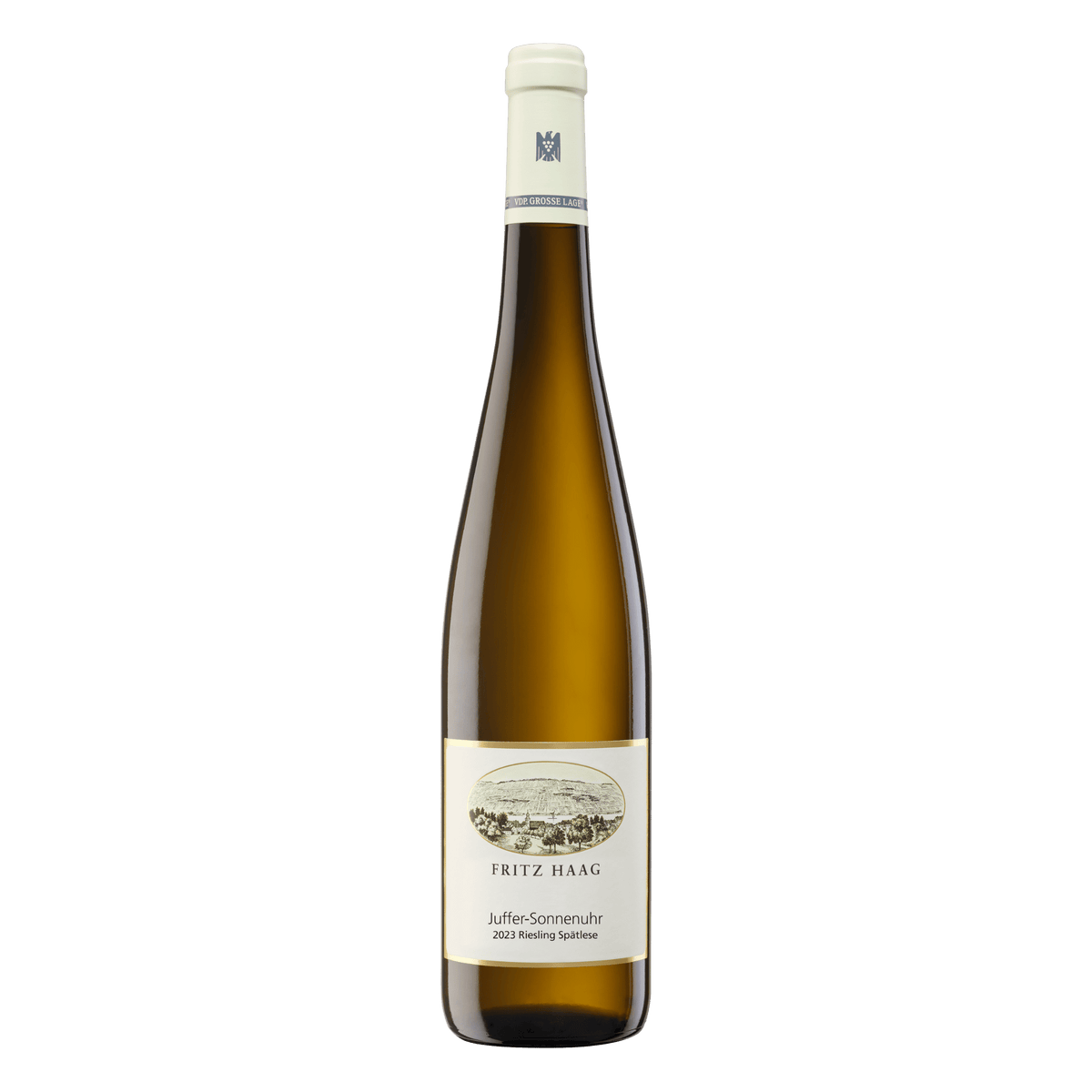
Fritz Haag
Fritz Haag Brauneberger Juffer Sonnenuhr Riesling Spätlese 2023
Fritz Haag Brauneberger Juffer Sonnenuhr Riesling Spätlese 2023
Couldn't load pickup availability
Description
Description
Fritz Haag Brauneberger Juffer Sonnenuhr Riesling Spätlese comes from the steepest heart of the Juffer, the parcel around the old sundial.
The Juffer Sonnenuhr is a small enclave within the larger Brauneberger Juffer, named for the sundial built into the slope, and it is generally held to be the finest section: the steepest gradient, the most direct southerly exposure and the thinnest layer of soil over fractured blue Devonian slate. Fritz Haag has held old vines here for generations. The grapes are harvested in successive passes, whole-bunch pressed and fermented slowly at low temperature in stainless steel and large old Fuder, then stopped with roughly 81 grams per litre of sugar remaining. Ageing on fine lees before an early bottling preserves the wine's transparency and the stony grip of the site.
Sweet yet weightless, with acidity holding everything in line; serve at 8 to 10 degrees alongside Thai or Sichuan food, foie gras, or fruit tarts.
*Every effort is made to ensure the current vintage is accurate; however, variations can occur. If you are after a specific vintage, please contact us prior to ordering.
Wine Details
Wine Details
Type: White Wine
Style: Sweet (fruity-sweet Spätlese, 81 g/L residual sugar, 7.7 g/L acidity)
Grape Varietal: Riesling
Tastes Like: A classic sweet Mosel Riesling Spätlese from a top single vineyard
Alcohol Percentage: 7.5%
Closure: Natural cork
Size: 750mL
Appellation: Prädikatswein Mosel (Germany's top quality category, graded by the ripeness of the grapes at harvest; Spätlese means "late harvest": grapes picked riper than for Kabinett). The Juffer Sonnenuhr is classified VDP.Grosse Lage, the top tier of the VDP growers' association's own vineyard ranking, comparable to a grand cru
Region: Brauneberg, Middle Mosel, Germany
Terroir: The Juffer Sonnenuhr, the heart of the Brauneberger Juffer, named after the sundial that stands among its vines; a steep slope facing south to south-west at 110-210 m above sea level, on extremely poor Devonian slate, across the river from the village
Aging: Gently pressed, fermented with its own natural yeasts, then six months on fine lees over winter and matured in stainless steel; released from 1 May of the year after harvest, as the VDP requires for fruity Prädikat wines from Grosse Lage sites
Serving Temperature: 8-10°C
Winery
Winery
Weingut Fritz Haag is a family estate in Brauneberg on the Middle Mosel, first documented in 1605, when the village was still called Dusemond. The village renamed itself Brauneberg in 1925 to draw on the fame of its great vineyard, the Juffer, which faces the village from the opposite bank of the river: a south-facing slope of weathered Devonian slate that runs for almost two kilometres along the left bank, with the Juffer Sonnenuhr, named after the sundial that stands among its vines, at its heart. Brauneberg's reputation is old: Thomas Jefferson rated its wine first quality in 1788, and Napoleon's 1804 tax survey of the Moselle vineyards confirmed its top standing. Wilhelm Haag, who came home to run the estate in 1957, led the Grosser Ring (today VDP.Mosel) for many years, and his younger son Oliver took over in 2005 and runs the estate with his wife Jessica. Every vine is Riesling, all five of the estate's sites are classified VDP.Grosse Lage, the association's top tier, the grapes are picked by hand on slopes as steep as 80 per cent, and the wines ferment with their own natural yeasts.
This Spätlese comes from the Juffer Sonnenuhr, the sundial slope that the estate calls the premier parcel of the Brauneberg. Spätlese means "late harvest": the grapes are picked riper than for Kabinett, and Haag makes this one in the traditional fruity-sweet Mosel style, with 81 g/L of residual sugar held in balance by 7.7 g/L of acidity at only 7.5% alcohol. The grapes are gently pressed and fermented with their own yeasts, and the young wine then rests on its fine lees for six months over winter before it is bottled. Its sweetness and lift make it a natural partner for spiced and savoury-sweet cooking, from smoked pork with dried fruit to a fragrant curry.
Food Pairings
Food Pairings
Spiced dishes: Thai red curry of pork with pineapple, or a Malay chicken rendang
Pork: Roast pork belly with crackling and baked apples, or Kassler (smoked pork loin) with braised red cabbage
Duck: Crisp-skinned duck breast with plum sauce and steamed bok choy
North African: Chicken tagine with apricots, honey and toasted almonds
Cheese Pairings
Cheese Pairings
Weisslacker: A strong, salty Bavarian washed-rind cheese from the Allgäu; the wine's sweetness softens its salt and its acidity cuts the rich paste
Tilsiter: A semi-firm, savoury cheese with a smeared rind; its salt and firm texture set off the sweetness of a Spätlese
Comté (18 months): A firm French mountain cheese with crunchy crystals; its dense texture and salt meet the wine's sugar and acidity in balance
Recipe
Recipe
Schlesisches Himmelreich (Silesian Smoked Pork Belly Braised with Dried Fruit, with Potato Dumplings)
Ingredients (Serves 4):
- 800 g smoked pork belly (Kassler belly or speck in one piece), rind removed
- 200 g dried apple rings
- 150 g dried pears, halved
- 100 g pitted prunes
- 1 cinnamon stick and 2 strips lemon zest
- 1 tbsp brown sugar
- 1 tbsp cornflour mixed with 2 tbsp cold water
- 1 tbsp lemon juice
- 1 kg floury potatoes (such as Sebago or russet), unpeeled
- 120 g potato starch (potato flour), plus extra for shaping
- 1 egg yolk
- 1 tsp salt and a pinch of ground nutmeg
- 2 tbsp chopped flat-leaf parsley, to serve
Instructions:
- Put the dried apples, pears and prunes in a bowl, cover with 1 L of cold water and soak for at least 4 hours or overnight.
- Boil the potatoes in their skins for 25-30 minutes until tender. Drain, peel while warm and press through a potato ricer onto a tray. Leave to cool completely, ideally for a few hours.
- Place the pork belly in a large saucepan, cover with 1.5 L of water, bring to a simmer and cook gently, partly covered, for 45 minutes.
- Add the soaked fruit with its soaking water, the cinnamon stick, lemon zest and brown sugar. Simmer for a further 30 minutes, until the pork is tender and the fruit is soft but holding its shape.
- Meanwhile, knead the cold riced potato with the potato starch, egg yolk, salt and nutmeg into a smooth, firm dough. Shape into 8 dumplings with floured hands.
- Lower the dumplings into a wide pot of salted water held just below the boil and poach for about 20 minutes, until they float and are cooked through. Do not let the water boil hard or they will break.
- Lift the pork out and keep warm. Remove the cinnamon and zest, stir the cornflour mixture into the fruit broth and simmer for 2 minutes until lightly thickened. Season with the lemon juice and a little salt.
- Slice the pork thickly and serve with the fruit and its sauce, the dumplings alongside and parsley scattered over.
Himmelreich, "heaven", is a dish from Silesia, where dried fruit from the autumn harvest was cooked with smoked pork through the winter months, and it has remained a family favourite in German kitchens ever since. The combination of salty smoked pork, sweet dried fruit and soft dumplings is just what a Sonnenuhr Spätlese is made for: the wine's sweetness echoes the fruit rather than fighting it, its acidity cuts the fat of the pork belly, and at 7.5% alcohol it stays light enough to keep the plate feeling fresh.