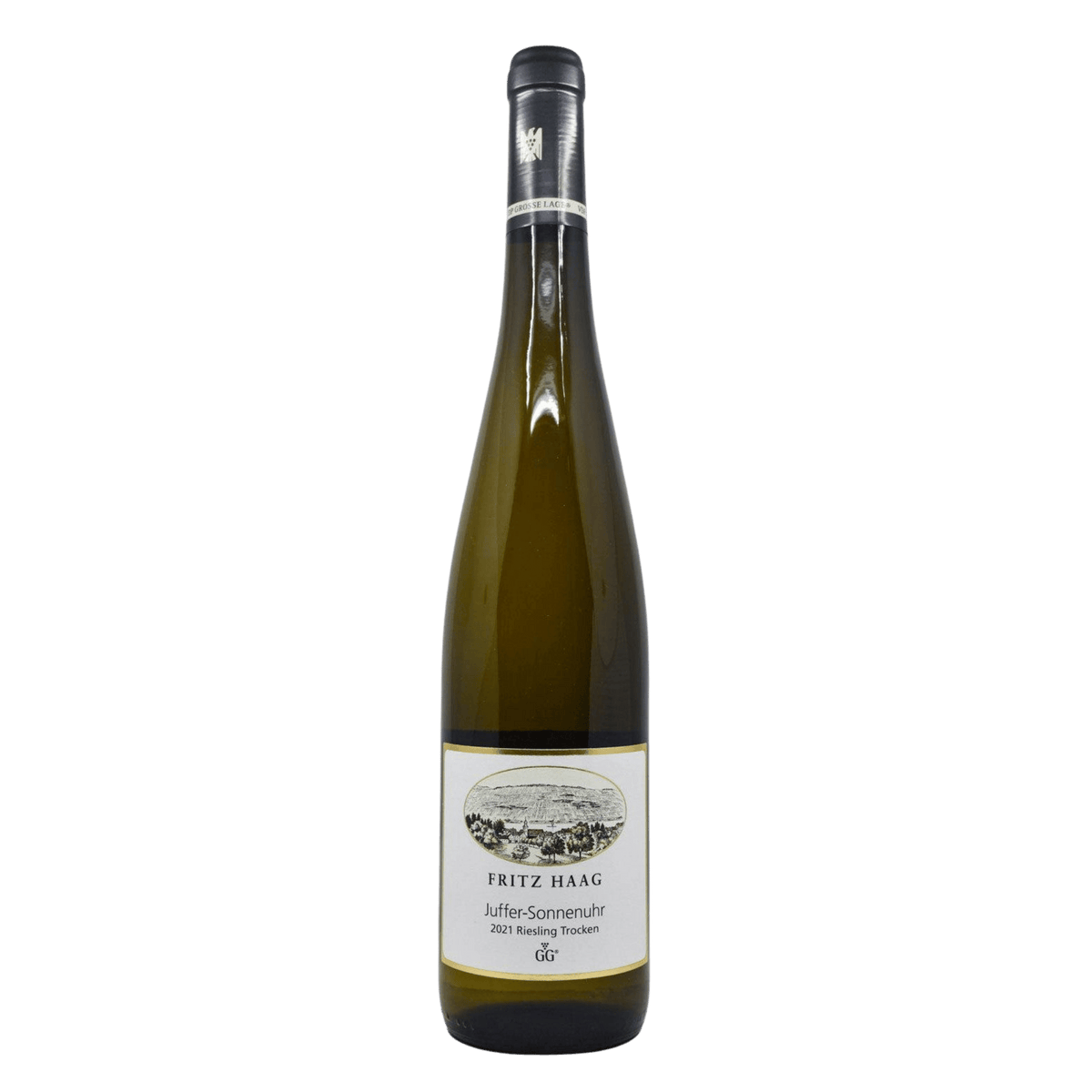
Fritz Haag
Fritz Haag Brauneberger Juffer Sonnenuhr Trocken GG 2022
Fritz Haag Brauneberger Juffer Sonnenuhr Trocken GG 2022
Couldn't load pickup availability
Description
Description
Fritz Haag Brauneberger Juffer Sonnenuhr Trocken GG is the estate's dry flagship, from the sundial heart of the Brauneberg slope.
The Juffer Sonnenuhr is the steepest and best-exposed core of the Brauneberg, marked by the sundial built into the hillside, where the slate is thinnest and the vines struggle hardest. Fritz Haag's holdings here include old ungrafted vines, and the parcel has long supplied the estate's most concentrated fruit. For the Grosses Gewächs the grapes are picked by hand in several passes, whole-bunch pressed, and fermented with ambient yeasts in stainless steel and traditional Fuder cask, then left on full lees over winter to build texture. The wine is bottled dry at 4 grams per litre of residual sugar and released a year after the harvest under VDP rules.
Dry, concentrated and very long, it suits lobster, sweetbreads and rich fish dishes; serve at 11 to 12 degrees.
*Every effort is made to ensure the current vintage is accurate; however, variations can occur. If you are after a specific vintage, please contact us prior to ordering.
Wine Details
Wine Details
Type: White Wine
Style: Dry (trocken)
Grape Varietal: Riesling
Tastes Like: A dry top-vineyard Mosel Riesling in the Grosses Gewächs style
Alcohol Percentage: 12.5%
Closure: Natural cork
Size: 750mL
Appellation: Qualitätswein Mosel, VDP.Grosses Gewächs (a dry wine from a top-classified VDP.Grosse Lage vineyard, picked by hand, released from 1 September of the year after harvest)
Region: Brauneberg, Middle Mosel, Germany
Terroir: The Juffer Sonnenuhr, the heart of the Brauneberger Juffer, named after the sundial among its vines: very steep, cliff-enclosed slopes of extremely poor slate facing south to south-west, 110-210 metres above sea level
Aging: Natural-yeast fermentation in 1,000 L oak Fuder casks and stainless steel, with extended lees contact; released 1 September 2023
Serving Temperature: 10-12°C
Winery
Winery
Weingut Fritz Haag is a family estate in Brauneberg on the Middle Mosel, first documented in 1605, when the village was still called Dusemond. The village renamed itself Brauneberg in 1925 to draw on the fame of its great vineyard, the Juffer, which faces the village from the opposite bank of the river: a south-facing slope of weathered Devonian slate that runs for almost two kilometres along the left bank, with the Juffer Sonnenuhr, named after the sundial that stands among its vines, at its heart. Brauneberg's reputation is old: Thomas Jefferson rated its wine first quality in 1788, and Napoleon's 1804 tax survey of the Moselle vineyards confirmed its top standing. Wilhelm Haag, who came home to run the estate in 1957, led the Grosser Ring (today VDP.Mosel) for many years, and his younger son Oliver took over in 2005 and runs the estate with his wife Jessica. Every vine is Riesling, all five of the estate's sites are classified VDP.Grosse Lage, the association's top tier, the grapes are picked by hand on slopes as steep as 80 per cent, and the wines ferment with their own natural yeasts.
The Juffer Sonnenuhr is the heart of the Juffer, the parcel the estate calls the premier site on the Brauneberg, and it takes its name from the sundial that stands among its vines. Its very steep, cliff-enclosed slopes face south to south-west on extremely poor slate, between 110 and 210 metres above sea level. Haag makes this Grosses Gewächs from its best and eldest parcels there, with a rigorous hand harvest, fermentation in 1,000-litre oak Fuder casks and stainless steel, and extended time on the lees. The 2022 is fully dry, with 2.8 g/L of residual sugar, 7.4 g/L of acidity and 12.5% alcohol. This is the bottle to open for a special dinner, or to lay down for years.
Food Pairings
Food Pairings
Shellfish: Grilled rock lobster or Moreton Bay bugs with lemon butter
Fish: Whole roasted snapper with fennel and potatoes
Poultry: Roast guinea fowl with bread sauce and roast parsnips
Veal: Wiener Schnitzel with lemon and a lamb's lettuce salad
Cheese Pairings
Cheese Pairings
Altenburger Ziegenkäse: A soft white-rind cheese of cow's and goat's milk from Thuringia, protected by name; its supple texture suits a dry wine with fine acidity
Beaufort: A firm Alpine cheese with real density, matched by the concentration of the Sonnenuhr's best parcels
Parmigiano Reggiano (24 months): Its salt and crystalline texture are refreshed by a bone-dry Riesling with 7.4 g/L of acidity
Recipe
Recipe
Pichelsteiner Eintopf (Bavarian Layered Stew of Beef, Pork and Lamb with Root Vegetables)
Ingredients (Serves 4):
- 300 g beef chuck, cut into 3 cm cubes
- 300 g pork shoulder, cut into 3 cm cubes
- 300 g lamb shoulder (or veal shoulder), cut into 3 cm cubes
- 40 g beef bone marrow from the butcher, sliced, or 40 g butter
- 2 brown onions, sliced
- 600 g waxy potatoes, peeled and cut into 2 cm cubes
- 3 carrots, sliced
- 300 g celeriac, peeled and cut into 2 cm cubes
- 2 leeks, white and pale green parts, sliced
- 1 litre beef stock
- 1 tsp dried marjoram
- Salt and freshly ground black pepper
- 3 tbsp chopped flat-leaf parsley
Instructions:
- Line the base of a large, heavy flameproof casserole with the marrow slices (or melt the butter in it) and set over medium heat.
- Add the meat in a single layer, a batch at a time if needed, and brown it lightly on all sides. Remove and set aside.
- Mix the potatoes, carrots, celeriac, leeks and onions in a bowl with the marjoram, 1 tsp salt and plenty of pepper.
- Layer the casserole: a third of the vegetables, half the meat, another third of the vegetables, the rest of the meat, then the remaining vegetables on top.
- Pour in the stock, which should come almost to the top layer. Bring to a gentle simmer.
- Cover tightly and cook over very low heat, or in a 160°C oven, for 1 hour 30 minutes to 2 hours, until the meat is tender. Do not stir: the layers should stay intact.
- Taste the broth and adjust the seasoning.
- Serve straight from the pot in deep bowls, scattered with parsley.
Pichelsteiner comes from the Bavarian Forest, where the town of Regen claims it and holds a festival in its honour. Three meats are layered with root vegetables and cooked slowly, unstirred, so the broth becomes rich while each layer keeps its shape. It is hearty, homely food, and it shows how well a great dry Riesling works at the table: the Sonnenuhr Grosses Gewächs has the 12.5% alcohol and weight to stand beside three meats, while its acidity and near-zero sweetness (2.8 g/L) cut through the fat and keep the stew from feeling heavy.