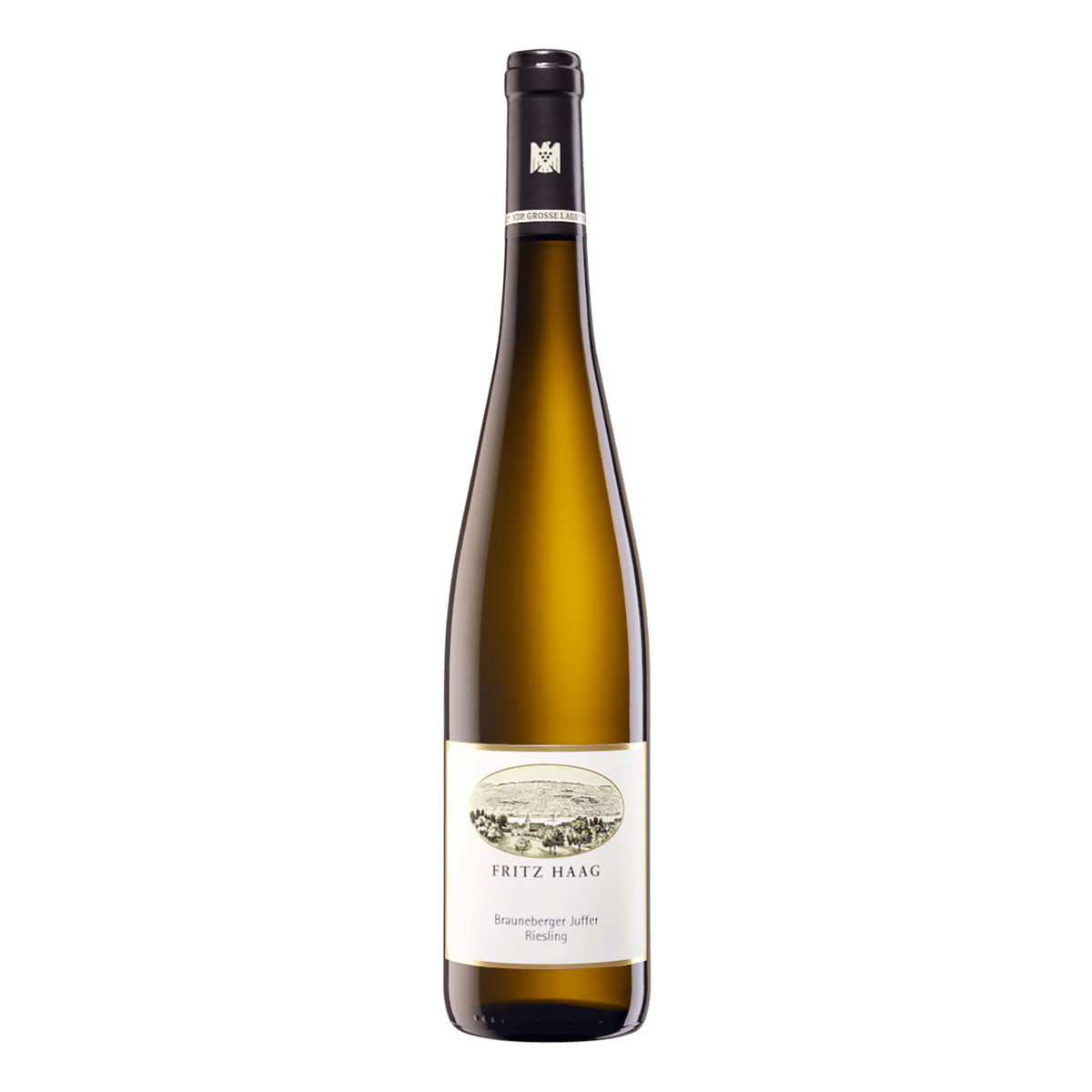
Fritz Haag
Fritz Haag Juffer Riesling GL 2022
Fritz Haag Juffer Riesling GL 2022
Couldn't load pickup availability
Description
Description
Fritz Haag Juffer Riesling GL is a near-dry Mosel Riesling from the estate's classified holdings on the Brauneberger Juffer.
Brauneberg sits on the left bank of the middle Mosel, its slope falling steeply to the river on grey and blue slate that radiates stored heat back onto the vines through the autumn. The Juffer covers the broad face of that hill, and Fritz Haag's parcels within it include old vines on the poorest, stoniest ground. Fruit for this wine is whole-bunch pressed, settled and fermented in stainless steel and traditional cask, and the fermentation runs almost to completion, leaving 13 grams per litre of sugar in the feinherb style. Low alcohol and searching slate acidity keep the balance firmly on the dry side of the palate.
Taut, low in alcohol and barely off-dry, it suits river fish, pork, and lightly spiced Asian food; serve at 9 to 11 degrees.
*Every effort is made to ensure the current vintage is accurate; however, variations can occur. If you are after a specific vintage, please contact us prior to ordering.
Wine Details
Wine Details
Type: White Wine
Style: Off-dry (feinherb)
Grape Varietal: Riesling
Tastes Like: An off-dry single-vineyard Mosel Riesling
Alcohol Percentage: 12%
Size: 750mL
Appellation: Qualitätswein Mosel, VDP.Grosse Lage (an off-dry wine from a vineyard ranked in the top tier of the VDP's classification; it is not a Grosses Gewächs, a name kept for dry wines)
Region: Brauneberg, Middle Mosel, Germany
Terroir: The Brauneberger Juffer, a pure south-facing slope of fine weathered Devonian slate running for almost two kilometres along the left bank of the Mosel, across the river from the village; gradients up to 80 per cent
Aging: Some skin contact, then natural-yeast fermentation and maturation in 1,000 L oak Fuder casks and stainless steel, in proportions that vary by vintage
Serving Temperature: 9-11°C
Winery
Winery
Weingut Fritz Haag is a family estate in Brauneberg on the Middle Mosel, first documented in 1605, when the village was still called Dusemond. The village renamed itself Brauneberg in 1925 to draw on the fame of its great vineyard, the Juffer, which faces the village from the opposite bank of the river: a south-facing slope of weathered Devonian slate that runs for almost two kilometres along the left bank, with the Juffer Sonnenuhr, named after the sundial that stands among its vines, at its heart. Brauneberg's reputation is old: Thomas Jefferson rated its wine first quality in 1788, and Napoleon's 1804 tax survey of the Moselle vineyards confirmed its top standing. Wilhelm Haag, who came home to run the estate in 1957, led the Grosser Ring (today VDP.Mosel) for many years, and his younger son Oliver took over in 2005 and runs the estate with his wife Jessica. Every vine is Riesling, all five of the estate's sites are classified VDP.Grosse Lage, the association's top tier, the grapes are picked by hand on slopes as steep as 80 per cent, and the wines ferment with their own natural yeasts.
This is Haag's Brauneberger Juffer Riesling feinherb, labelled VDP.Grosse Lage: an off-dry single-vineyard wine from the estate's best-known site. It is not a Grosses Gewächs, a name the VDP keeps for dry wines, but it comes from the same top-classified ground. After some skin contact, the juice ferments with its natural yeasts in 1,000-litre oak Fuder casks and stainless steel, in proportions that change with each vintage. The 2022 has 12% alcohol, 11.5 g/L of residual sugar and 8.1 g/L of acidity, so it sits just off dry. Open it when a dry wine feels too austere for the food and a Kabinett too sweet: with pork, Japanese food or a weekend roast chicken.
Food Pairings
Food Pairings
Pork: Slow-roasted pork belly with crackling and braised red apple
Japanese: Tonkatsu with shredded cabbage, or teriyaki salmon with rice
Poultry: Roast chicken with tarragon butter and buttered carrots
Vegetarian: Pumpkin and sage ravioli with brown butter
Cheese Pairings
Cheese Pairings
Weisslacker: A strong, salty Bavarian washed-rind cheese from the Allgäu; the touch of sweetness in this feinherb softens its salt while the acidity cleans the palate
Romadur: A soft Bavarian washed-rind cheese whose rich, yielding texture is lifted by the wine's acidity
Comté: A firm French mountain cheese whose density matches a single-vineyard wine of 12% alcohol
Recipe
Recipe
Drei im Weggla (Nuremberg Bratwurst in a Crusty Roll with Mustard and Radish Salad)
Ingredients (Serves 4):
- 12 Nürnberger Rostbratwürste (finger-length Nuremberg sausages), or 12 thin pork chipolatas with a little dried marjoram
- 4 crusty white bread rolls (Brötchen)
- 1 tbsp vegetable oil
- 4 tbsp medium-hot German mustard
- 2 bunches radishes (about 300 g), trimmed
- 1 small red onion, very finely sliced
- 2 tbsp white wine vinegar
- 3 tbsp sunflower oil
- 1 tsp caster sugar
- 2 tbsp snipped chives
- Salt and freshly ground black pepper
Instructions:
- Make the radish salad first. Slice the radishes thinly, toss them with 1 tsp salt and leave for 10 minutes, then squeeze out the liquid.
- Whisk the vinegar, sunflower oil and sugar with a pinch of pepper, then toss with the radishes, red onion and chives. Set aside while you cook the sausages.
- Heat a barbecue grill or a heavy frying pan over medium-high heat and brush lightly with the vegetable oil.
- Grill the sausages for 6-8 minutes, turning often, until browned all over and cooked through. Nuremberg sausages are thin, so they cook quickly.
- Meanwhile, warm the rolls in a 180°C oven for 3-4 minutes so the crust crackles.
- Split each roll along one side without cutting right through, spread with mustard and tuck in three hot sausages side by side.
- Serve at once with the radish salad and extra mustard on the side.
Drei im Weggla, "three in a roll" in the Franconian dialect, is Nuremberg's street snack, sold from grills around the old town and at its markets. Nürnberger Rostbratwürste are small, thin pork sausages seasoned with marjoram, with protected status tied to the city. The fat and salt of the sausages and the heat of the mustard call for a wine with acidity and a little sweetness, and this Juffer feinherb has both: its 11.5 g/L of residual sugar softens the mustard, its acidity cuts the richness of the pork, and at 12% alcohol it has the weight to stand up to grilled meat.