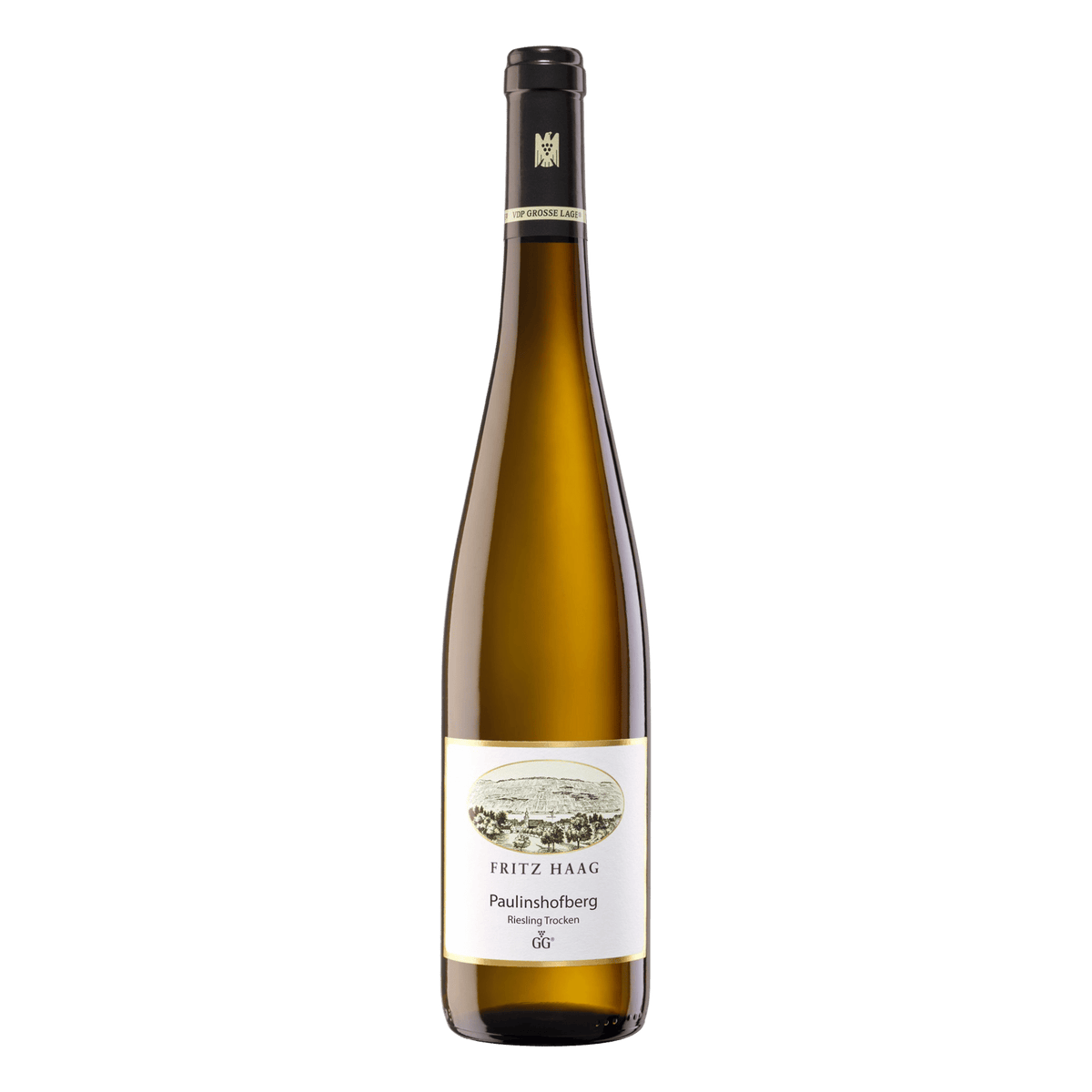
Fritz Haag
Fritz Haag Paulinshofberg Trocken GG 2022
Fritz Haag Paulinshofberg Trocken GG 2022
Couldn't load pickup availability
Description
Description
Fritz Haag Paulinshofberg Trocken GG is a dry Grosses Gewächs Riesling from the steep slate slope at Kesten, just downriver from the family's home vineyards.
The Paulinshofberg rises above Kesten on the same left-bank stretch of the middle Mosel as Brauneberg, its south to south-west facing terraces built on weathered grey slate with a warm, quick-draining profile. Fritz Haag has extended into the site in recent years and farms it as it does its home parcels, with hand picking, low yields and successive passes through the rows. The must is fermented with ambient yeasts in stainless steel and traditional Fuder cask, left on full lees through the winter and bottled without fining down to dryness, finishing at 5 grams per litre of residual sugar. The Grosses Gewächs designation requires the wine to be released a year after harvest.
Dry, firm and slate-driven with a little more breadth than the home vineyards, it suits pike-perch, pork and hard cheeses; serve at 10 to 12 degrees.
*Every effort is made to ensure the current vintage is accurate; however, variations can occur. If you are after a specific vintage, please contact us prior to ordering.
Wine Details
Wine Details
Type: White Wine
Style: Dry (trocken)
Grape Varietal: Riesling
Tastes Like: A dry single-vineyard Mosel Riesling (Grosses Gewächs)
Alcohol Percentage: 12.5%
Closure: Natural cork
Size: 750mL
Appellation: Qualitätswein Mosel, VDP.Grosses Gewächs (a dry wine from a top-classified VDP.Grosse Lage vineyard, picked by hand, released from 1 September of the year after harvest)
Region: Kesten, Middle Mosel, Germany
Terroir: The Kestener Paulinshofberg, neighbour of the Brauneberger Juffer: a south-facing slope of weathered blue and grey Devonian slate with loamy clay slate and deeper soils; reclassified as VDP.Grosse Lage in 2019
Aging: Natural-yeast fermentation and ageing in 1,000 L oak Fuder casks and stainless steel, on fine lees without stirring; released 1 September 2023
Serving Temperature: 10-12°C
Winery
Winery
Weingut Fritz Haag is a family estate in Brauneberg on the Middle Mosel, first documented in 1605, when the village was still called Dusemond. The village renamed itself Brauneberg in 1925 to draw on the fame of its great vineyard, the Juffer, which faces the village from the opposite bank of the river: a south-facing slope of weathered Devonian slate that runs for almost two kilometres along the left bank, with the Juffer Sonnenuhr, named after the sundial that stands among its vines, at its heart. Brauneberg's reputation is old: Thomas Jefferson rated its wine first quality in 1788, and Napoleon's 1804 tax survey of the Moselle vineyards confirmed its top standing. Wilhelm Haag, who came home to run the estate in 1957, led the Grosser Ring (today VDP.Mosel) for many years, and his younger son Oliver took over in 2005 and runs the estate with his wife Jessica. Every vine is Riesling, all five of the estate's sites are classified VDP.Grosse Lage, the association's top tier, the grapes are picked by hand on slopes as steep as 80 per cent, and the wines ferment with their own natural yeasts.
The Kestener Paulinshofberg lies in the village of Kesten, next to the Juffer, with deeper soils of weathered blue and grey Devonian slate and loamy clay slate. The VDP reclassified it as a Grosse Lage in 2019, and Haag makes a Grosses Gewächs from it: a dry wine from a top-classified site, picked by hand and held back until 1 September of the year after harvest. The 2022 fermented and aged in a mix of 1,000-litre oak Fuder casks and stainless steel, finishing at 12.5% alcohol with 4.3 g/L of residual sugar and 7.7 g/L of acidity. It comes from a year with a dry summer and autumn rain, when careful timing and selection at harvest made the difference. Open it with fish and shellfish, or give it a few years in the cellar.
Food Pairings
Food Pairings
Shellfish: Freshly shucked Sydney rock oysters, or grilled scampi with garlic butter
Fish: Pan-fried King George whiting with brown butter and capers
Vegetables: White asparagus with hollandaise and boiled new potatoes
Poultry: Poached chicken breast with a light herb cream sauce
Cheese Pairings
Cheese Pairings
German fresh goat's cheese (Ziegenfrischkäse): Soft and fresh, its creamy texture is matched by the acidity of a dry Grosses Gewächs
Crottin de Chavignol: A small, firm Loire goat's cheese whose chalky texture and salt suit a bone-dry, high-acid white
Gruyère: A firm Swiss mountain cheese with enough density to meet a 12.5% single-vineyard Riesling
Recipe
Recipe
Aal grün mit Petersilienkartoffeln (Eel in Green Herb Sauce with Parsley Potatoes)
Ingredients (Serves 4):
- 800 g eel, skinned, cleaned and cut into 5 cm pieces (or 800 g firm white fish fillets such as blue-eye trevalla or ling, cut into large chunks)
- 1 litre water
- 1 small brown onion, halved
- 1 bay leaf, 5 black peppercorns and 1 tsp salt
- 2 tbsp white wine vinegar
- 1 kg waxy potatoes, peeled and halved
- 60 g butter
- 2 tbsp plain flour
- 150 mL pouring cream
- 1 large bunch flat-leaf parsley, finely chopped (about 1 cup)
- 2 tbsp chopped dill
- 1 tsp lemon juice
Instructions:
- Bring the water to the boil with the onion, bay leaf, peppercorns, salt and vinegar, and simmer for 10 minutes.
- Lower the heat so the liquid barely trembles, add the eel and poach for 12-15 minutes, until tender (white fish needs only 6-8 minutes). Lift out the fish and keep it warm; strain and reserve 500 mL of the poaching liquid.
- Meanwhile, boil the potatoes in salted water for 15-20 minutes until tender. Drain, then toss with 30 g of the butter and half the parsley.
- Melt the remaining 30 g butter in a saucepan, stir in the flour and cook for 1 minute without browning.
- Gradually whisk in the reserved poaching liquid and simmer for 5 minutes, stirring, until smooth and lightly thickened.
- Stir in the cream, the rest of the parsley and the dill, add the lemon juice and season. The sauce should be bright green and pourable.
- Return the fish to the sauce and warm through gently for 2 minutes.
- Serve the fish and sauce with the parsley potatoes.
Aal grün is a classic of northern Germany, cooked in Hamburg and along the lower Elbe, where eel was once caught in great numbers. Eel is rich and oily, and here it sits in a buttery, cream-enriched sauce, so the wine needs real acidity and no sweetness. The Paulinshofberg Grosses Gewächs is dry at 4.3 g/L of residual sugar, its 7.7 g/L of acidity cuts through the fat of the eel and the cream, and its 12.5% alcohol gives it the body to match a substantial plate.