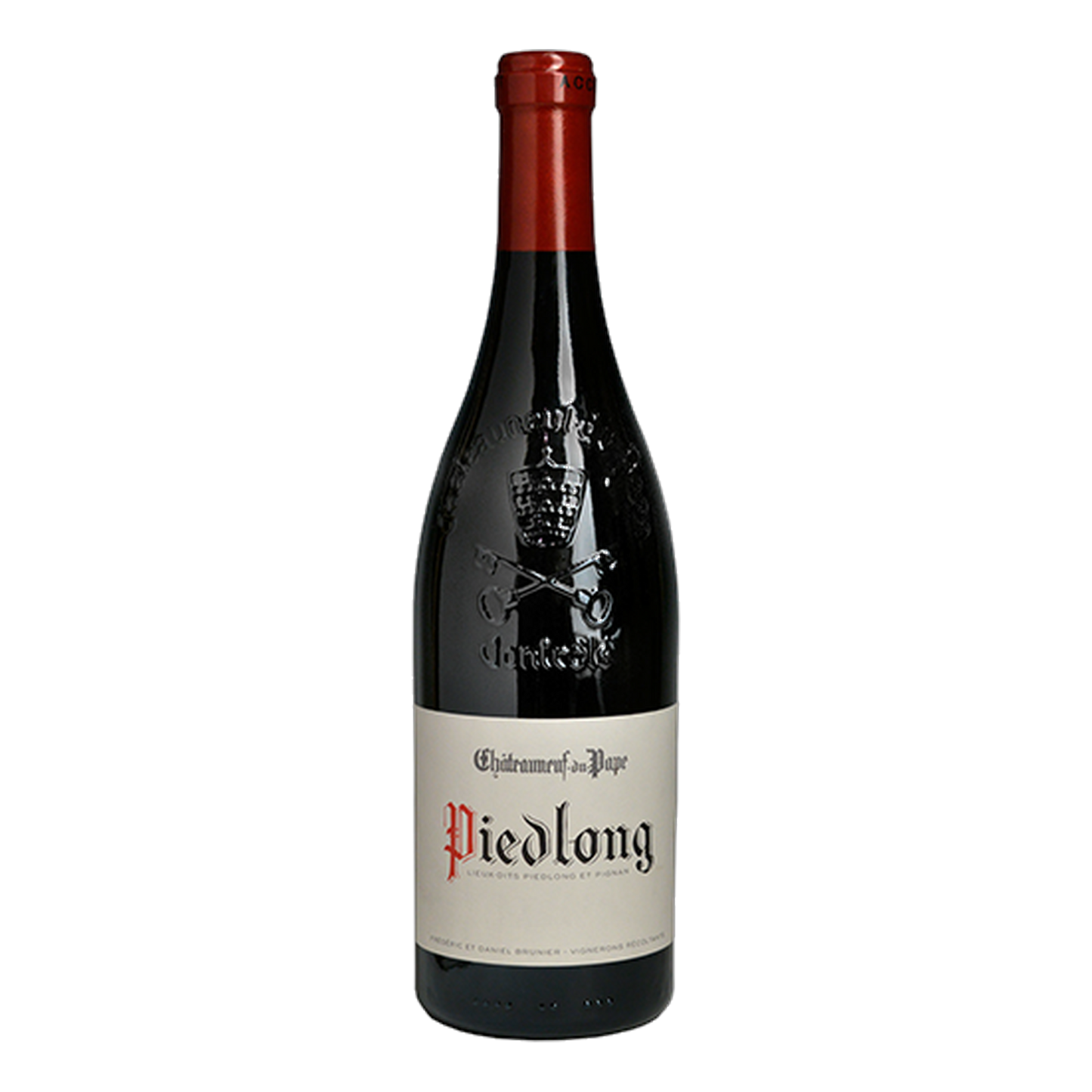
Vieux Telegraphe
Vieux Télégraphe Piedlong Châteauneuf-du-Pape 2022
Vieux Télégraphe Piedlong Châteauneuf-du-Pape 2022
This incredible drop is from our South Australia warehouse - please allow 7-10 days for dispatch. It's well worth the wait!
If your order includes wine from a different warehouse, everything is shipped together once this item is ready.
Couldn't load pickup availability
Description
Description
Vieux Télégraphe Piedlong Châteauneuf-du-Pape is a single-parcel red from the Brunier family, drawn from a lieu-dit close to their celebrated La Crau plateau.
Domaine du Vieux Télégraphe takes its name from the Chappe optical telegraph relay that once stood on the La Crau plateau, in the south-east of Châteauneuf-du-Pape near Bédarrides. Hippolyte Brunier planted the first vines there in 1891 and the family still farms the same ground, a high terrace paved in galets roulés, the rounded quartzite stones left behind by the Rhône, over red clay and sand. Piedlong is a separate parcel, vinified and bottled on its own rather than folded into the flagship. Grenache leads, with Mourvèdre for structure, fermented in the traditional manner and matured in large old foudres.
Suited to slow-cooked lamb, a daube of beef or hard sheep's milk cheeses; serve at around 16 to 18 degrees. It rewards a decade or more in a cool cellar.
*Every effort is made to ensure the current vintage is accurate; however, variations can occur. If you are after a specific vintage, please contact us prior to ordering.
Wine Details
Wine Details
Type: Red Wine
Style: Full-bodied, Structured, Age-worthy
Grape Varietal: Grenache (90%), Mourvèdre (10%)
Tastes Like: Comparable to a pure, Grenache-led southern Rhône red, with a touch of Mourvèdre for firmness
Alcohol Percentage: 14.5% (est.)
Size: 750mL
Appellation: Châteauneuf-du-Pape AOP (Appellation d'Origine Protégée, France's protected designation of origin: the grapes must come from the appellation's five villages around Châteauneuf-du-Pape and follow its rules)
Region: Piedlong, Châteauneuf-du-Pape, Southern Rhône, France
Terroir: The Piedlong plateau north of the village of Châteauneuf-du-Pape, the highest ground in the appellation: molasse covered in galets roulés (Grenache); the Mourvèdre comes from the nearby Pignan site, sandy topsoil over clay and the soft local stone known as pierre de Châteauneuf
Aging: Selectively destemmed and fermented for at least 30 days in concrete and wooden vats; around two years before release, including time in large oak foudres; bottled unfined and unfiltered
Serving Temperature: 16-18°C
Winery
Winery
Domaine du Vieux Télégraphe is the Brunier family's estate in Châteauneuf-du-Pape, in the southern Rhône. Its story begins in 1891, when Henri Brunier gave his son Hippolyte land on La Crau, a high, stony plateau in the south-east of the appellation, and Hippolyte planted the first vines. The estate is named after the Chappe optical telegraph tower that once stood on the plateau, one of the relay stations that passed signals across France before the electric telegraph. Henri Brunier, the fourth generation, rebuilt the estate after the Second World War; his sons Daniel and Frédéric joined in the early 1980s, and the next generation, Nicolas, Édouard and Manon, has worked alongside them since the mid-2010s. The vineyards are farmed along organic lines, and the family's other wines include Domaine Les Pallières in Gigondas, bought in 1998 with their American importer Kermit Lynch, and reds from vineyards in the Vaucluse and at the foot of the Dentelles de Montmirail and Mont Ventoux.
Piedlong is a single-site Châteauneuf-du-Pape from the north of the appellation, made by the Brunier family alongside their La Crau. The Grenache, 90% of the blend, comes from old vines of around 70 years on the Piedlong plateau, the highest point in Châteauneuf, where the soil is soft molasse under a cover of rounded stones; the remaining 10% is Mourvèdre from the neighbouring Pignan site. The wine is fermented for a month or more in concrete and wooden vats and given around two years before release, with time in large old foudres, then bottled unfined and unfiltered. The 2022 is a wine to enjoy with cheese and slow-cooked dishes, and it will reward several more years in the cellar.
Food Pairings
Food Pairings
Cheese dishes: Baked goat cheese with thyme, garlic and toasted country bread
Beef: Beef cheeks braised in red wine with carrots
Mushrooms: Wild mushroom tart with thyme
Pork: Roast pork belly with fennel seeds and garlic
Cheese Pairings
Cheese Pairings
Pélardon: A small goat cheese from the Cévennes, nutty and tangy beside a full-bodied Grenache
Tome des Bauges: A rustic Savoie mountain cheese whose earthy rind suits a mature southern red
Roquefort: The great sheep's milk blue from the south; the ripeness of Grenache softens its salt
Recipe
Recipe
Banon Rôti en Papillote (Baked Banon Goat Cheese with Thyme, Garlic and Olive Oil)
Ingredients (Serves 4):
- 2 Banon cheeses (about 90 g each), still in their chestnut leaves, or 2 small ripe goat cheeses of a similar size
- 4 large vine leaves in brine, rinsed and patted dry (if your cheese has no leaves)
- 2 garlic cloves, thinly sliced
- 4 sprigs thyme or winter savory
- 1 sprig rosemary, leaves picked
- 3 tbsp extra virgin olive oil
- Freshly ground black pepper
- 1 baguette or country loaf, sliced and toasted
- 100 g bitter salad leaves (frisée, rocket or radicchio)
- 1 tbsp red wine vinegar and 2 tbsp olive oil, for the dressing
- 40 g walnuts, toasted
Instructions:
- Preheat the oven to 200°C.
- If your cheeses come without leaves, wrap each one loosely in two vine leaves.
- Cut two squares of baking paper, each large enough to wrap a cheese. Place a cheese in the centre of each, open the leaves on top and tuck in the garlic, thyme and rosemary.
- Drizzle each cheese with oil and grind over some pepper, then fold the paper into a loose parcel and twist the ends to seal.
- Bake for 10 to 12 minutes, until the cheese is soft and just starting to run.
- While it bakes, toss the salad leaves with the vinegar, oil and walnuts.
- Open the parcels at the table and serve the warm cheese with the toasted bread for scooping, and the salad on the side.
Banon, from the village of the same name in the hills of Haute-Provence, is a goat cheese wrapped in chestnut leaves and tied with raffia, an old way of keeping it. Baked in a parcel with garlic and herbs, it turns soft and spoonable, with a tang that a light red would struggle with. Piedlong's old-vine Grenache has the generous body to match the warm cheese, and its touch of Mourvèdre gives grip to cut through the oil and creaminess.