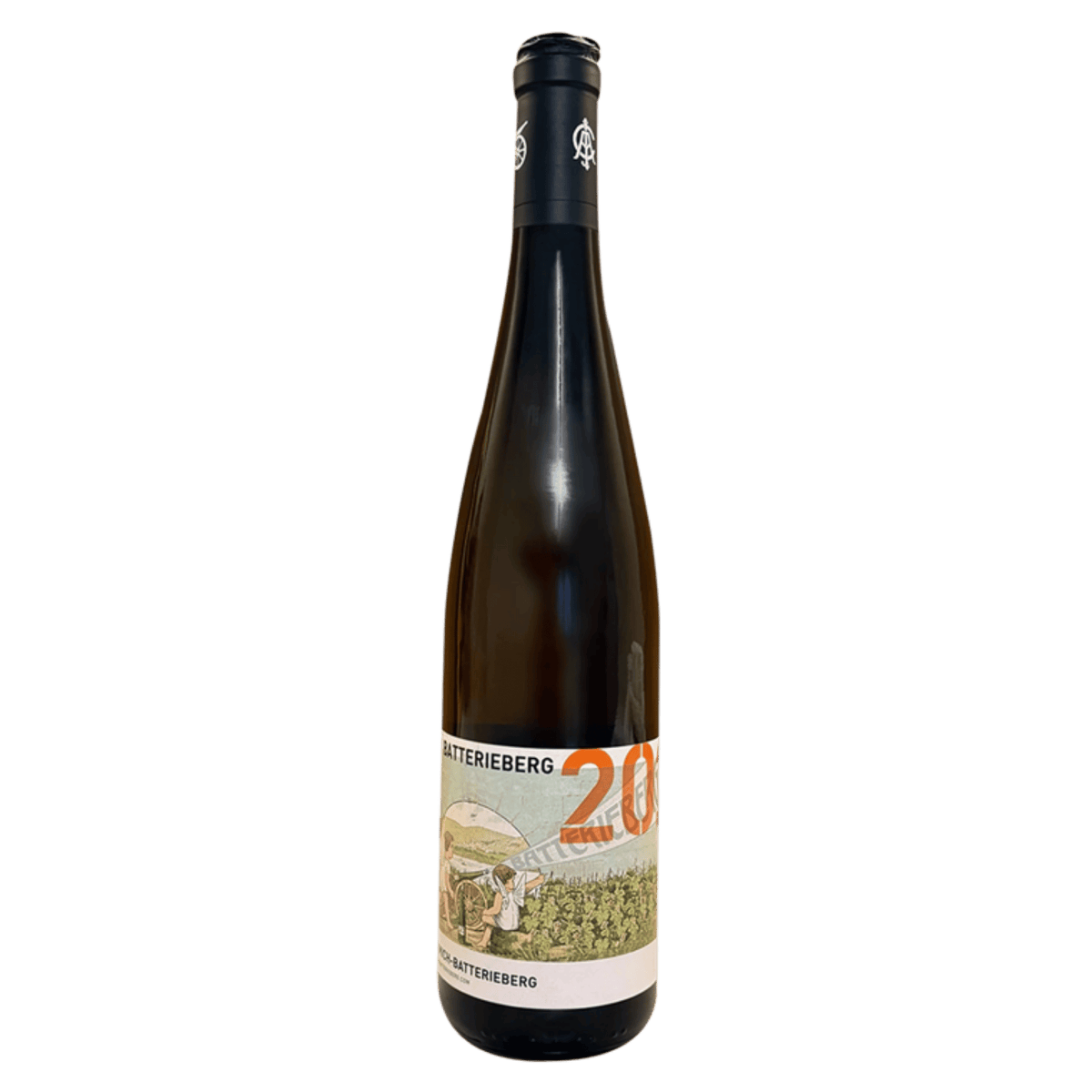
Weingut Immich-Batterieberg
Weingut Immich-Batterieberg Enkircher Batterieberg Riesling 2024
Weingut Immich-Batterieberg Enkircher Batterieberg Riesling 2024
Couldn't load pickup availability
Description
Description
Weingut Immich-Batterieberg Enkircher Batterieberg Riesling is a dry, single-vineyard Riesling from the Batterieberg, the grand cru site above Enkirch that gives the estate its name.
The Batterieberg vineyard was carved from a sheer slate cliff face using explosives between 1841 and 1845 by Carl August Immich, creating a distinctive parcel of grey, quartz-flecked slate that is still farmed with old, largely ungrafted vines today. Since 2009 the estate has been run by winemaker Gernot Kollmann, who farms all of the steep, terraced vineyards organically and by hand, favouring spontaneous fermentation and minimal cellar intervention to let the slate soils speak clearly through the wines.
Sourced from one of the Mosel's most singular sites, it is a precise, mineral-driven dry Riesling built for those seeking a true expression of place.
*Every effort is made to ensure the current vintage is accurate; however, variations can occur. If you are after a specific vintage, please contact us prior to ordering.
Wine Details
Wine Details
Type: White Wine
Style: Dry (trocken)
Grape Varietal: Riesling
Tastes Like: A dry single-vineyard Mosel Riesling from old vines
Alcohol Percentage: 12.5%
Closure: Natural cork
Size: 750mL
Appellation: Qualitätswein Mosel (Germany's quality wine category: grapes from one named wine region, here the Mosel, made to that category's rules)
Region: Enkirch, Mosel, Germany
Terroir: The Batterieberg, a monopole (the estate owns all of it) within the Zeppwingert in the Starkenburger Fels between Enkirch and Traben-Trarbach; grey slate with an unusually high share of quartzite; old vines
Aging: Made to the estate's cellar rules: no commercial yeasts, enzymes or fining agents, nothing added to raise sugar or lower acidity, and a long time on full lees in the estate's cellar
Serving Temperature: 8-10°C
Winery
Winery
Immich-Batterieberg is one of the oldest wine estates on the Mosel, in the village of Enkirch. Its buildings first appear in a record from the year 908, and the Immich family made wine here for more than five centuries, until 1989. The estate is named after the Batterieberg vineyard, which Carl August Immich blasted out of the slate cliffs above Enkirch in the 1840s; the name comes from the blasting charges, Sprengbatterien in German. In the Prussian vineyard classification of 1868 the four Enkirch sites were placed in the highest class. Since the 2009 vintage the estate has been run by Gernot Kollmann, who previously worked at Van Volxem in the Saar. The extremely steep slopes are farmed organically and largely by hand, and a high proportion of the old vines grow on their own roots, never grafted. In the cellar there are no commercial yeasts, enzymes or fining agents, nothing is added to raise sugar or lower acidity, and the wines spend a long time on their full lees in wooden casks and stainless steel.
Enkircher Batterieberg Riesling 2024 comes from the vineyard that gives the estate its name. The Batterieberg is a monopole, meaning the estate owns all of it, and it sits within the Zeppwingert in the Starkenburger Fels between Enkirch and Traben-Trarbach, on grey slate with an unusually high share of quartzite. The grapes come from the estate's own old vines, and the wine is made dry, at 12.5%, and sealed with a natural cork. It is the estate's signature site, made for roast goose, duck and pork at a long autumn or winter lunch.
Food Pairings
Food Pairings
Roast poultry: Roast goose or duck legs with red cabbage and dumplings
Pork: Roast pork belly with crackling, or pork knuckle with sauerkraut
Game birds: Pheasant with bacon and savoy cabbage, or quail with lentils
Side dishes: Creamed savoy cabbage, potato dumplings or braised chestnuts
Cheese Pairings
Cheese Pairings
Allgäuer Bergkäse (12 months): A firm mountain cheese from the Allgäu, whose depth matches a fuller, 12.5% single-vineyard Riesling
Weisslacker: A pungent Bavarian washed-rind cheese; the wine's acidity and dryness keep the salty paste in check
Munster: A washed-rind cheese from the Vosges, just across the Rhine, that a dry, structured Riesling partners better than most reds
Recipe
Recipe
Gänsekeule mit Klößen und Wirsing (Braised Goose Legs with Potato Dumplings and Creamed Savoy Cabbage)
Ingredients (Serves 4):
- 4 goose legs (or 4 large duck legs)
- Salt, pepper and 2 tsp dried marjoram
- 1 brown onion, 1 carrot and 1 apple, roughly chopped
- 500 mL chicken stock
- 1 tbsp cornflour mixed with 2 tbsp water
- For the dumplings: 1 kg floury potatoes, boiled in their skins the day before and peeled
- 100 g potato starch (or cornflour)
- 1 egg, salt and a pinch of nutmeg
- 1 slice white bread, cubed and fried in butter
- For the cabbage: 1 small savoy cabbage, finely shredded
- 30 g butter, 1 small onion, finely chopped
- 150 mL pouring cream, salt, pepper and nutmeg
Instructions:
- Preheat the oven to 160°C. Rub the goose legs with salt, pepper and marjoram.
- Brown the legs skin side down in a heavy ovenproof pan over medium heat for 10 minutes to render the fat, then turn and brown the other side. Pour off most of the fat and keep it for cooking.
- Add the onion, carrot and apple around the legs, pour in the stock, cover and braise in the oven for 1 1/2 hours (1 hour for duck).
- Uncover, raise the oven to 200°C and roast for a further 20-30 minutes until the skin is crisp.
- Meanwhile, grate the cold potatoes finely, then knead with the potato starch, egg, salt and nutmeg to a smooth dough. With wet hands shape 8 dumplings, pressing a few fried bread cubes into the centre of each.
- Lower the dumplings into a large pot of salted water that is barely simmering and cook for 20 minutes, until they float and are cooked through.
- For the cabbage, blanch the shredded savoy in boiling salted water for 2 minutes and drain. Soften the onion in butter, add the cabbage and cream and simmer for 5 minutes until thickened; season with salt, pepper and nutmeg.
- Strain the braising liquid into a small pan, skim off the fat, bring to the boil and thicken with the cornflour mixture.
- Serve the goose legs with the dumplings, creamed cabbage and plenty of gravy.
Goose is the traditional dish for St Martin's Day on 11 November in Germany, and it stays on tables right through the festive season. The meat is rich and the dumplings and cream sauce add weight, so the wine needs both body and acidity: the Batterieberg has the structure and 12.5% weight to stand beside goose, and its dryness and acidity cut cleanly through the fat.