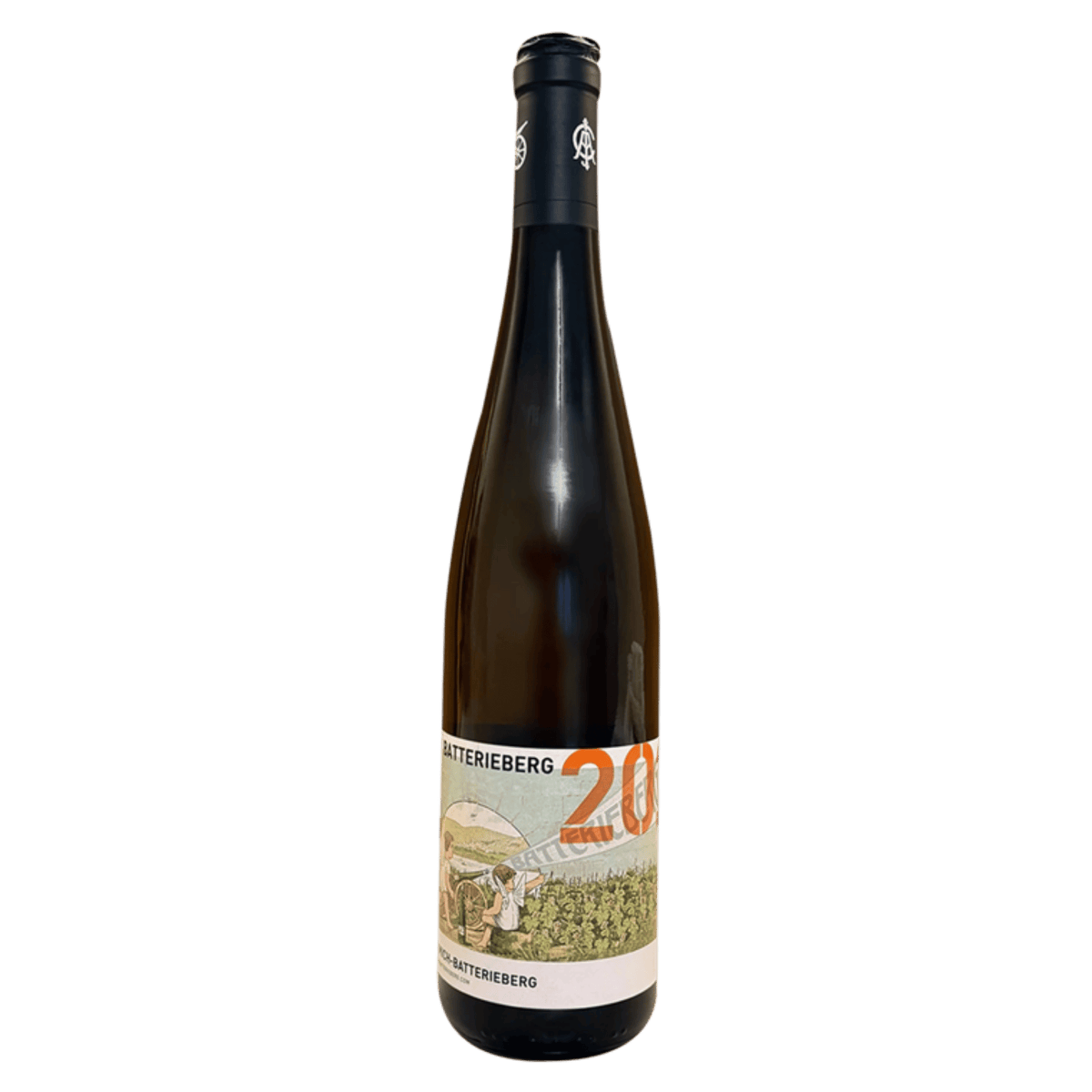
Weingut Immich-Batterieberg
Weingut Immich-Batterieberg Enkircher Ellergrub Riesling 2023
Weingut Immich-Batterieberg Enkircher Ellergrub Riesling 2023
Couldn't load pickup availability
Description
Description
Weingut Immich-Batterieberg Enkircher Ellergrub Riesling is a dry, single-vineyard Riesling from the Ellergrub, widely regarded as the estate's finest site.
The Ellergrub is a small parcel of classic blue Devonian slate above Enkirch, farmed at very low yields and considered by winemaker Gernot Kollmann to be the standout vineyard among the estate's holdings. Kollmann has run Immich-Batterieberg since 2009, farming the steep, terraced vineyards organically and by hand, working largely ungrafted old vines and favouring spontaneous fermentation and minimal cellar intervention to let the slate terroir speak clearly through the wine.
Grown on one of the Mosel's standout blue-slate sites, it is a taut, mineral-driven dry Riesling for those seeking real depth and precision.
*Every effort is made to ensure the current vintage is accurate; however, variations can occur. If you are after a specific vintage, please contact us prior to ordering.
Wine Details
Wine Details
Type: White Wine
Style: Dry (trocken), labelled Trocken: 3.2 g/L residual sugar
Grape Varietal: Riesling
Tastes Like: A dry single-vineyard Mosel Riesling from very old vines
Closure: Natural cork
Size: 750mL
Appellation: Qualitätswein Mosel (Germany's quality wine category: grapes from one named wine region, here the Mosel, made to that category's rules), Trocken (dry)
Region: Enkirch, Mosel, Germany
Terroir: The Ellergrub, the estate's steepest and largest Enkirch site, just upstream of the Batterieberg; fine, dark blue slate; very old vines
Aging: 2023 vintage: 11 months in a small wooden barrel; no commercial yeasts, enzymes or fining agents, and nothing added to raise sugar or lower acidity
Serving Temperature: 8-10°C
Winery
Winery
Immich-Batterieberg is one of the oldest wine estates on the Mosel, in the village of Enkirch. Its buildings first appear in a record from the year 908, and the Immich family made wine here for more than five centuries, until 1989. The estate is named after the Batterieberg vineyard, which Carl August Immich blasted out of the slate cliffs above Enkirch in the 1840s; the name comes from the blasting charges, Sprengbatterien in German. In the Prussian vineyard classification of 1868 the four Enkirch sites were placed in the highest class. Since the 2009 vintage the estate has been run by Gernot Kollmann, who previously worked at Van Volxem in the Saar. The extremely steep slopes are farmed organically and largely by hand, and a high proportion of the old vines grow on their own roots, never grafted. In the cellar there are no commercial yeasts, enzymes or fining agents, nothing is added to raise sugar or lower acidity, and the wines spend a long time on their full lees in wooden casks and stainless steel.
Enkircher Ellergrub Riesling 2023 comes from the estate's steepest and largest site in Enkirch, just upstream of the Batterieberg, where very old vines grow in fine, dark blue slate. The 2023 spent 11 months in a small wooden barrel and was finished dry, labelled Trocken with 3.2 g/L of residual sugar, and sealed with a natural cork. It is a serious single-vineyard Riesling that suits vegetarian cooking with grains, herbs and roast vegetables as well as white meats.
Food Pairings
Food Pairings
Vegetarian mains: Green-spelt patties, mushroom dumplings with cream sauce or a leek and potato gratin
Grains and pulses: Spelt risotto with peas, lentil salad with mustard dressing or barley with roast root vegetables
White meats: Veal in cream sauce (Zürcher Geschnetzeltes) or roast chicken with tarragon
Salads: Cucumber salad with dill and sour cream, or a warm potato and herb salad
Cheese Pairings
Cheese Pairings
Allgäuer Sennalpkäse: An Alpine summer cheese from the Allgäu, firm and full, which matches a wine with the weight of barrel ageing
Edelpilzkäse: A German blue cheese; the wine's dry finish and acidity give a clean contrast to the salt
Ziegenfrischkäse (fresh goat's cheese): Soft and tangy, a simple match that lets a dry, structured Riesling show its acidity
Recipe
Recipe
Grünkernküchle mit Gurkensalat (Green-Spelt Patties with Cucumber Salad)
Ingredients (Serves 4):
- 200 g Grünkern (green spelt), coarsely ground or cracked (from health food stores; or use coarse bulgur or cracked freekeh)
- 500 mL vegetable stock
- 1 brown onion, finely chopped
- 1 carrot, finely grated
- 1 tbsp butter
- 2 eggs
- 50 g dry breadcrumbs, plus extra if needed
- 2 tbsp chopped parsley and 1 tsp dried marjoram
- 1 tsp Dijon or medium German mustard
- Salt, pepper and a pinch of nutmeg
- 4 tbsp vegetable oil, for frying
- For the cucumber salad: 2 Lebanese cucumbers, thinly sliced
- 150 g sour cream or thick plain yoghurt
- 1 tbsp white wine vinegar, 1 tsp caster sugar and 2 tbsp chopped dill
Instructions:
- Bring the stock to the boil, stir in the Grünkern, cover and simmer gently for 10 minutes, then turn off the heat and leave to swell for 20 minutes until the liquid is absorbed. Cool.
- Soften the onion and carrot in the butter for 5 minutes and add to the grain.
- Mix in the eggs, breadcrumbs, parsley, marjoram, mustard, salt, pepper and nutmeg. The mixture should hold together; add more breadcrumbs if it is too wet.
- Rest the mixture for 15 minutes, then shape into 8 flat patties with wet hands.
- For the salad, salt the cucumber slices lightly, leave 10 minutes, then squeeze out the liquid.
- Stir together the sour cream, vinegar, sugar and dill, season, and fold through the cucumber. Chill until needed.
- Heat the oil in a large frying pan over medium heat and fry the patties for 4-5 minutes on each side until deep golden and crisp.
- Serve hot with the cold cucumber salad and boiled potatoes if you like.
Grünkern is a speciality of Baden in south-west Germany: spelt harvested before it is fully ripe and dried over heat, then cooked into soups and the patties known as Küchle. The patties are fried and the salad is dressed with sour cream and vinegar, so the wine needs to be dry with good acidity and enough weight not to be lost; the Ellergrub, made dry and given 11 months in wood, has the structure to match.